
He was the oldest of five
children and the son of a manufacturing worker, growing up on a farm in
Indiana. He remembers wearing a T-shirt protesting Democratic presidential
candidate John Kerry while attending Liberty, a Christian university founded by
conservative pastor and televangelist Jerry Falwell.
Twenty years later, Justin
Douglas is a Democrat seeking a seat in the US Congress.
He is one of about thirty
Christian white clergy members, including pastors, seminary students, and other
religious leaders, who are rumored to be prospective Democratic candidates in
the upcoming midterm elections. Twelve of them are already running. Many claim
that their faith is personally calling them into politics, even as they
emphasize the separation of church and state.
A traditional racial
division is broken by this movement. Due to the power of the religious right
and the party’s dominance among evangelical voters, white pastors who run for
government are more likely to be Republicans than Black pastors.
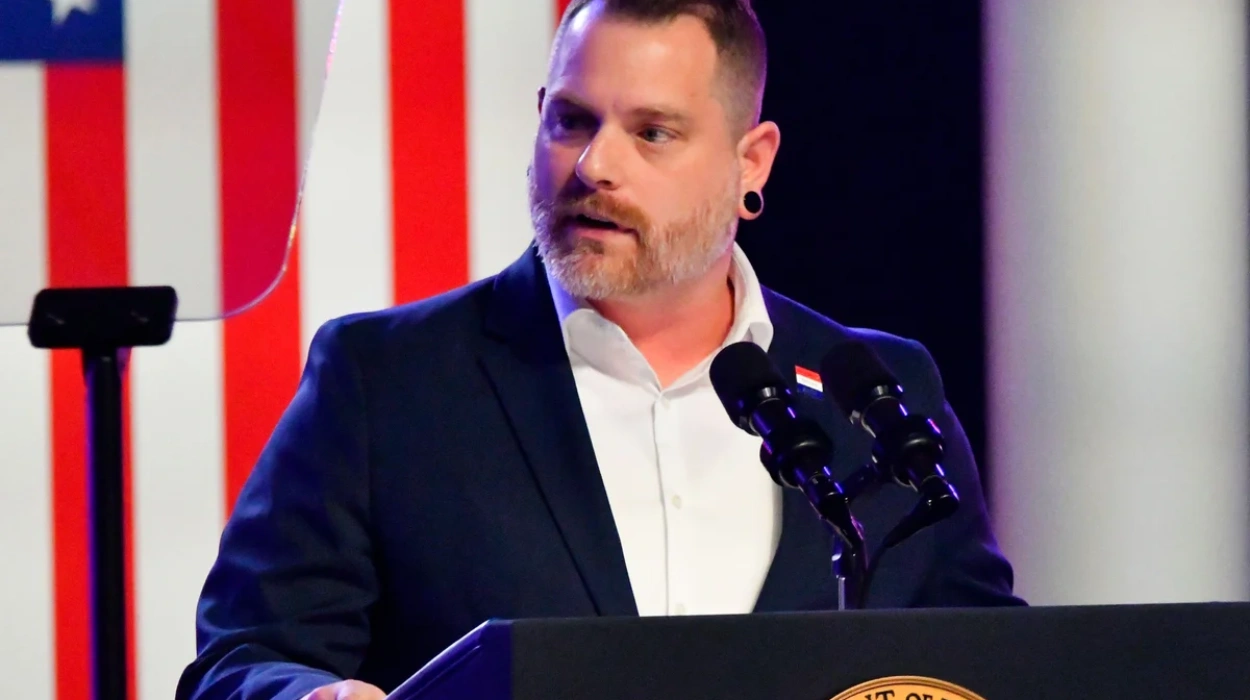
Douglas, a 41-year-old
Harrisburg, Pennsylvania resident, is part of a new generation of Christian
leftists who want to alter that perception by making sure the Democratic brand
can appeal to white working-class
churchgoers as well as college-educated urbanites.
“We’ve seen Democrats time
and time again sell out working class people and we’ve seen Democrats time and
time again look like liberal elitists who are looking down on people who think
going to church on Sunday is a core part of their life,”
said Douglas, who has been
in ministry for more than 20 years.
“Some people might feel judged for that.
But I also think the
stereotypes of Republicans being pro-faith are bullshit too. We’re seeing a
current administration bastardise faith almost every day. They used the Lord’s
Prayer in a propaganda video for what they’re now calling the Department of
War. That should have had every single evangelical’s bells and whistles and
alarms going off in their head: this is sacrilegious.”
For many years, especially
in the South, a large number of white Christians were nonpartisan and
frequently cast Democratic ballots. However, the Democratic Party’s character
was beginning to change toward secular liberalism, feminism, and civil rights
by the late 1960s and early 1970s. A growing number of white conservative
Christians felt cut off from the party they had long belonged to.
The Internal Revenue
Service started denying tax-exempt status to private schools that discriminated
based on race in the middle of the 1970s, which contributed to the racial
divide. Seeing this as federal overreach, conservative Christian leaders like
Jerry Falwell seized on abortion as a topic that could be addressed in terms of
religion.
Along with feminism, sex
education, and homosexual rights, Falwell’s group The Moral Majority used
abortion as a more general emblem of moral decay.
While Black churchgoers
continued to support Democrats, they defected to Republican Ronald Reagan, and
by the end of the 1980s, white evangelicals had emerged as one of the most
reliably Republican voting blocs. Under Donald Trump, that has continued for
the past ten years. While supporters view it as a blunt tool to protect a
church under attack by a godless liberal culture, others view it as vulgar and
unchristian.
Hillary Clinton, a fellow
Democrat, received just 16% of the white evangelical vote in 2016, compared to
60% for Carter in 1976. Doug Pagitt, a pastor and executive director of the
progressive Christian organization Vote Common Good, saw the unsettling shift.
In Iowa, state legislator
Sarah Trone Garriott, an Evangelical Lutheran minister, is requesting blessing
from her party to run against Democratic peremptory Zach Nunn in what’s
formerly anticipated to be one of the most important congressional contests in
the country.
Robb Ryerse, a former
Republican and Christian pastor in Arkansas, is running against Congressman
Steve Womack with the banner” Faith, Family & Freedom,” which is
more constantly used in Democratic crusade accoutrements .
According to Ryerse, the
development of Christian nationalism and the fact that Trump entered 85% of the
white evangelical vote in the former time’s presidential election, according to
a Public Religion Research Institute (PRRI) check, are contributing factors to
the decision of white church to run for government.
Ryerse said:
“We realise
hey, our churches and the people in our churches have been duped by this guy
and so rather than hope someone else will clean up the problem, what we’ve seen
is a lot of pastors respond with, you know what, I’m going to jump in and I’m
going to be a part of the solution.
On a more positive note,
there’s also that notion we need to do something for the common good. There’s
so much alignment between what I believe personally is good for my neighbour, what
it means to love my neighbour, and how that aligns with what public policy
ought to be.”
How are Democratic voters responding to clergy candidacies?
Popular choosers are responding appreciatively to church
educations, especially those white church campaigners who emphasize progressive
Christian values that are at odds with Trump’s conduct and rhetoric. Numerous
Popular choosers see these campaigners as offering a faith- grounded volition
to the Christian chauvinist and MAGA- aligned leadership current in the
Republican Party.
A growing number of Popular choosers with religious
individualities are open to advancing for campaigners who openly integrate
faith and progressive politics, viewing this as a way to reclaim religious
converse from the far right.
At the same time, successful outreach examples like Pennsylvania
Governor Josh Shapiro’s crusade show that Egalitarians who directly engage
faith choosers and communicate dispatches of addition and common good can make
stronger support.