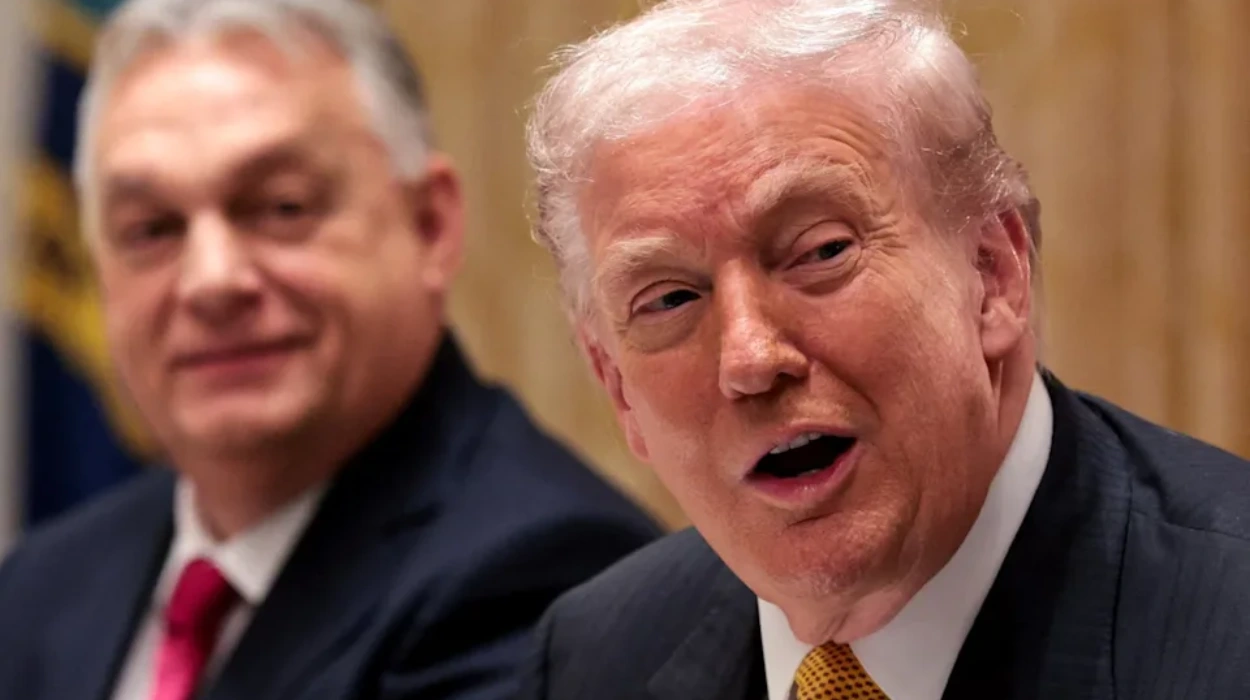

Speaking in the Cabinet
Room during a bilateral meeting and lunch with Hungarian Prime Minister Viktor
Orban, who has spent years undermining his nation’s democratic safeguards to
make it almost impossible for his Fidesz to lose power, Trump was deep in a meandering
soliloquy about how Democratic victories in Tuesday’s off-year elections were
the consequence of “lying” about his record on
“affordability” when he was asked how to put an end to what is
currently the longest government shutdown in American history.
In response, he informed
the gathered media that Senate Republicans should use the so-called
“nuclear option” to abandon the upper chamber’s filibuster rule as
the “way to do it.”
“I am totally in favor of
terminating the filibuster, and we would be back to work within 10 minutes
after that vote took place, and lots of other good things would happen. And it
doesn’t make any sense that a Republican would not want to do that,”
he said.
Then, after the Senate removed the minority party’s
ability to block legislation, he rattled off a list of partisan proposals he
would push for Congress to pass. These included a national voter identification
mandate and a ban on postal balloting, which he has falsely claimed is
“corrupt” and rife with “fraud.”
Trump claimed that if those
laws were sent to his desk, Republicans “would never lose” the next
midterm elections. According to current polling, his party is certain to lose
both the House majority and the Senate.
Without a filibuster rule
in place, he added, Republicans would “never lose the general
election” because they would “have produced so many different things
for our people.”
“If we terminate the
filibuster, the country will be open within 10 minutes after that termination,
because we’ll take a second vote, which is the opening of the country, and the
Republicans will vote to open the country,”
he said.
He later added that
bipartisanship “didn’t work” and warned that keeping the Senate’s supermajority
requirement would keep the GOP “in a slog with the Democrats” during which
“very little for either party will be done.”
Due to a centuries-old
quirk in parliamentary procedure that permits the minority party to prevent
up-or-down votes on bills that can’t garner support from at least 60 senators,
the filibuster rule, which dates back to a revision of the chamber’s standing
rules under then-vice president Aaron Burr in 1806, has frustrated presidents
and congressional majorities from both parties.
When progressive Democrats
held unified control of Washington from 2021 to 2023, they attempted to outlaw
the practice, but the entire Republican minority in the House and a number of
Democratic senators voted against it.
Days after his party
suffered crushing defeats in the New Jersey and Virginia gubernatorial
elections at the hands of voters incensed over his administration’s inability
to address rising prices contributing to an ever-increasing cost of living in
the United States, the president demanded to dismantle one of the few remaining
safeguards against unbridled GOP power in Washington.
citing the laser-focused
campaigns of Virginia Governor-elect Abigail Spanberger and New Jersey
Governor-elect Mikie Sherrill, who concentrated on “affordability”
Trump claimed that the Democrats’ emphasis on “affordability” was
“a con job,” just one year after voters in the 2024 presidential
election cited rising costs as the reason for his reelection.
“Prices are down under the
Trump administration, and they’re down substantially … gasoline is way down,
and the other big thing is … inflation is way down … we did a great job on
groceries and affordability. The The only problem is the fake news. You people
don’t want to report it,”
he said.
“The reason I don’t want to
talk about affordability is because everybody knows that it’s far less
expensive under Trump than it was under sleepy Joe Biden and the prices are way
down.”
How would eliminating the supermajority affect filibuster use in
the Senate?
Without the filibuster, legislation could be passed with a simple
maturity 51 votes rather of the current 60 making it easier for the maturity
party to legislate its legislative docket fleetly.
rescinding this rule would reduce the power of the nonage and
could lead to more prejudiced, nippy policy changes, especially on contentious
issues. still, numerous legislators, including significant numbers within both
parties, have expressed enterprises that barring the filibuster could lead to
increased polarization and undermine the Senate’s part as a chamber of extended
deliberation and agreement.
The move would be seen as a major procedural shift, frequently
appertained to as the “ nuclear option,” and could unnaturally alter the
legislative process, with both short- term advantages for the maturity and
long- term pitfalls of legislative insecurity and prejudiced corrosion.