
Summary
- Senate
committee condemns Boeing’s health care cuts. - Cuts
impact thousands of Boeing employees and families. - Lawmakers
criticize reductions amid rising healthcare costs nationally.
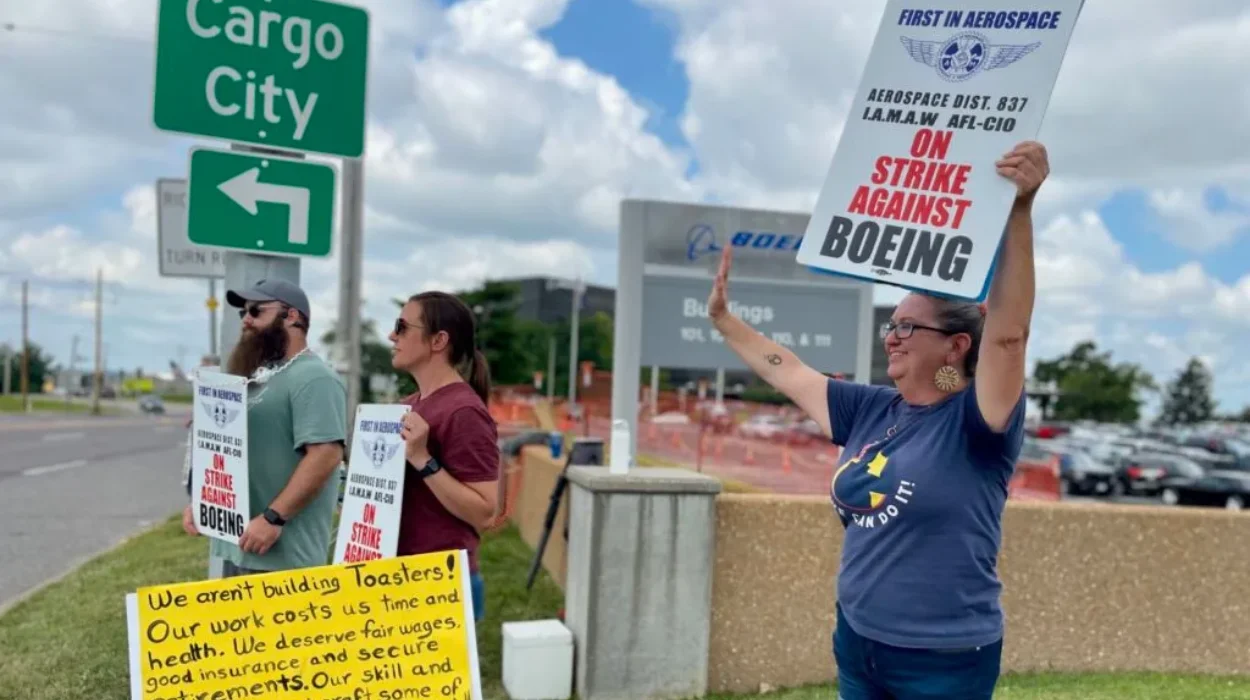
Christy Williams, an assembly mechanic, goes on strike
outside of Boeing Aerospace, her place of employment in Berkeley, Missouri. In
order to obtain higher pay and retirement benefits, she joined 3,200 other
International Association of Machinists and Aerospace Workers union members who
went on strike at midnight on August 4. (The Missouri Independent/Rebecca
Rivas).
During a committee hearing on Wednesday, both Republican and
Democratic U.S. senators expressed their indignation over Boeing’s decision to
deny health care to 3,000 striking employees at its sites in the St. Louis
region.
Additionally, they charged that the biggest aerospace
corporation in the world had not provided its employees with a fair
contract.
Josh Arnold is a St. Louis union member who oversees a
Boeing program that provides support for the FA-18 Super Hornets fighter
aircraft used by the U.S. Navy.
Arnold, who is also a union shop steward for the
International Association of Machinists and Aerospace Workers District 837,
said the cost difference between the company’s offer and union’s ask is half
the cost of one F-15 fighter jet.
“We’re going to blow our shoulders out drilling on titanium
for four years to make 96 F-15s,”
Arnold said, noting that they’ll also make a
number of other fighter jets, weapons, launch systems and flight simulators.
“We’re saying we’re going to deliver all of that to you. We want a fraction of
1% of one of the programs. And that’s when [the company] said, ‘Cut your health
care. Get back to work.’”
Following the hearing on Wednesday afternoon, Boeing
revealed a revised settlement offer that reduces some of the terms of the
company’s initial offer that sparked the Aug. 4 strike. After two days of talks
with union negotiators and a federal mediator, the new offer was made.
Hawley claimed during the Senate committee hearing that
Boeing’s position in the Missouri strike talks is indicative of the firm being
“stripmined for parts” from its former self.
“Over the last 30 years, Boeing has transformed from a
company known for safety excellence to a company with its safety record in
shambles,”
Markey said.
“At the same time, the company, which was once working
in partnership with its unions, has turned hostile.”
It “makes you wonder how Boeing can ever expect to
restore its safety culture,” Markey added, referring to the company’s
refusal to accept a reasonable contract with striking machinist workers.
“It tells us that they don’t value us,”
Arnold said.
“It
tells us that they’re seeking to maximize shareholder value by limiting inputs
like wages for laborers. That’s us. We produce the value, but we don’t get any
piece of that value, or as little of a piece as they can allow to get by with.”
What legislative actions could restore worker benefits?
This would amend the National Labor Relations Act to
strengthen protections for workers who organize and inclusively bargain.
It includes measures similar as tripling back pay for unfairly fired
workers, allowing private suits for violations, and assessing
fiscal penalties on employers who intrude with workers’ rights.
This policy would boost stipend, ameliorate food
security, and reduce poverty for low- income workers, directly impacting
benefits and profitable well- being.
Governments can ordain broader social security schemes
to cover all workers, including informal sectors, furnishing
benefits similar to health insurance, disability, and survivors’
benefits. Further effective penalties for labor law violations and better
monitoring can insure employers misbehave with benefit
provisions.