
Summary
- ‘No
Kings’ protests planned for October 18 across U.S. - Organizers
expect historic turnout with millions participating. - Protests
oppose Trump’s authoritarian policies and military crackdowns.
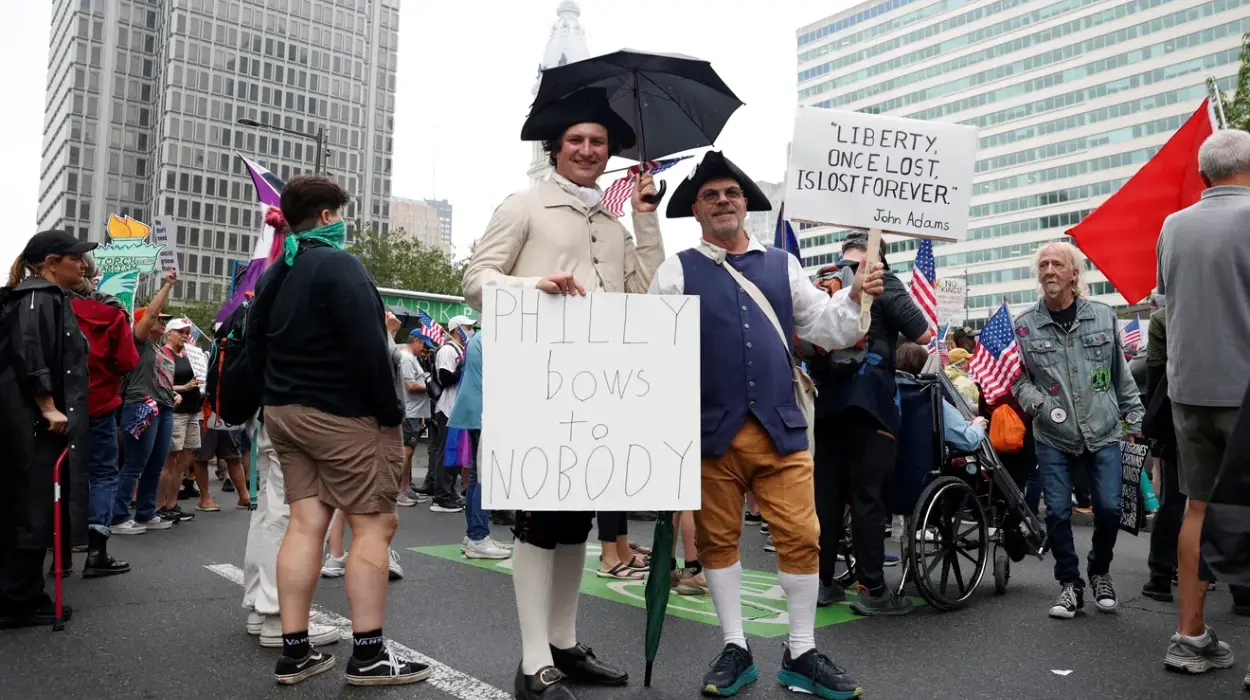
Even though the “No Kings” protests on October 18
have the same name as their predecessor, organizers anticipate an unprecedented
turnout for what they hope would be the biggest protest day in contemporary
American history.
“The anger level is way higher”
than it was in
June for the last protests of the same name, said Public Citizen copresident
Lisa Gilbert, one of the organizers.
“It’s not just policies we don’t like
… but it’s also actual chipping away at democracy, at foundational rights and
prerogatives that we all expect. … People are saying ‘I’ve never been moved to
action before, but now I feel like I have to.’”
Activists and organizers have seen a difference in the last
four months. They claim that the Trump administration has weakened First
Amendment rights, increased immigration enforcement, deployed military into a
number of Democratic-controlled communities, and drastically altered American
health care.
“If you’re not scared, you’re not paying attention. These
folks are serious. They are actively trying to take away your constitutional
right to peaceful protest, and that is how authoritarian regimes work,”
said
Indivisible cofounder Ezra Levin, another of the organizers.
“They fear
more than anything one thing, which is the mass, peaceful, organized population
pushing back against their unpopular designs on the system.”
Along with Indivisible and Public Citizen, the hosting
organizations include several unions and grassroots organizations like 50501
that have been established since Election Day 2024, as well as established
activism groups like MoveOn, the American Civil Liberties Union, the Human
Rights Campaign, and Working Families Power.
The 1,800 activities planned prior to the June 14 protests
of the same name are dwarfed by the 2,500 events planned in large cities,
suburbs, and small towns across the country. In addition to Boston, New York,
Atlanta, Kansas City, San Francisco, Chicago, New Orleans, and Bozeman,
Montana, anchor activities are scheduled outside the Capitol in Washington, DC.
According to organizer Jacqueline Denny, 57, Worth Fighting
For Routt County has organized a “mile long line for democracy,” in which
participants will wave signs along a main thoroughfare in the Colorado alpine
town of Steamboat Springs.
Denny said about 1,500 people turned out in June and she
expects more people Oct. 18 in response to ICE actions in the area.
“They are taking our people and terrifying our people, and
that feels so much more personal,”
she said.
She expects some people to protest over fears that public
lands could be sold or destroyed. Others are likely to come out over Trump’s
threats to crack down on protests, she said.
The need to demonstrate
“feels very real and crucial right
now,”
Denny said.
On October 13, Sean Duffy, the secretary of transportation,
told Fox News that he anticipated millions of people attending would be
“part of antifa, paid protesters.” (Antifa, which stands for
“antifascist,” is a loosely organized, unleadered organization of
activists who Republicans frequently accuse of committing violent crimes in
public.)
Republicans were hearing that Democrats wouldn’t reopen the
government until after the protests because “they can’t face their rabid
base,” according to Republican House Speaker Mike Johnson of Louisiana on
Fox News on October 10. New York Senate Minority Leader Chuck Schumer has come
under fire from activists for voting with Republicans in March to prevent a
government shutdown at that time.
“The theory we have right now ‒ they have a ‘hate
America’ rally that’s scheduled for October 18 on the National Mall,”
Johnson said.
“It’s all the pro-Hamas wing and antifa people; they are all
coming out.”
Still, Levin acknowledged the backdrop of the government
shutdown and said activists were watching whether elected Democrats stand with
them in opposition to Trump.
“I’m telling every elected Democrat now who I talk to that
the cavalry is coming in on October 18th. We’re going to have millions of
people out, and if you are fighting back against this regime, if you’re
standing strong, they’re going to be celebrating it,'”
he said.
“And
on the flip side, if you surrender again, primary season is around the corner,
and people are going to be looking for new leadership.”
The Washington protest is planned at the base of the
Capitol. So far, only one member of Congress, Sen. Chris Murphy, a Democrat
from Connecticut, is scheduled to speak.
Trump “wants to stifle speech. The best way to prevent
your speech from being stifled is having so many people exercising their First
Amendment rights together that he can’t possibly arrest all of them,” Hunter
Dunn, a national spokesperson for the protest group 50501, told USA TODAY. “And
that’s how you weaken him.”
Earlier protests held by this coalition have been
overwhelmingly peaceful. Local organizers are required to undergo security and
de-escalation training as part of setting up protests, they say.
“We’re making really clear that what we want to achieve
here is peaceful. We are taking to the streets to exercise our First Amendment
rights and speak out. We are not planning anything in any way that could be
misconstrued as violence. And we are working hard to protect people, providing
lots of training and preparation and creating systems and mechanisms to make
sure that people who turn out are safe,”
Public Citizen’s Gilbert said.
The “No Kings” protests aren’t a place to cause
trouble, said Rev. Paul Raushenbush, president of Interfaith Alliance, which is
mobilizing faith groups nationwide to participate.
“If you’re out there like really wanting to get arrested,
there’s a place for that. No Kings is not that,”
he said. “No Kings is joyfully
showing up.”
Seema Kanani, a health care worker and naturalized citizen
who attended the first “No Kings” protest as well as other protests
since 2020, told USA TODAY she isn’t afraid to attend.
“I deeply believe in nonviolence, protesting and
organizing, especially being a person of East Indian heritage and being an
immigrant myself,”
she said. Instead, it’s her teenage children who are worried
she could be arrested, or worse.
“I always have to actually calm their anxiety more so
than my own. But no, I am not at all worried because all of these protests, the
one thing in common is they’re peaceful.”
How are local authorities preparing for the protests?
City authorities, along with the police, are coordinating
with the organizers of the protest to understand the anticipated rally route,
expected number of participants, and timing of the protest. o get clarity on
communication channels and safety planning.
The authorities are increasing police presence across key
locations expected to see large crowds and are deploying officers with
specialized crowd control training while maintaining a calm and measured
demeanor to avoid escalation.
There are also plans to address potential road closures,
re-route traffic, and modify train service to accommodate protesters and ease
congestion.
Authorities are also increasing their monitoring practices
by using CCTV footage and information from social media to identify locations
likely to see trouble, or individuals likely to cause disruption, allowing them
to intervene early.