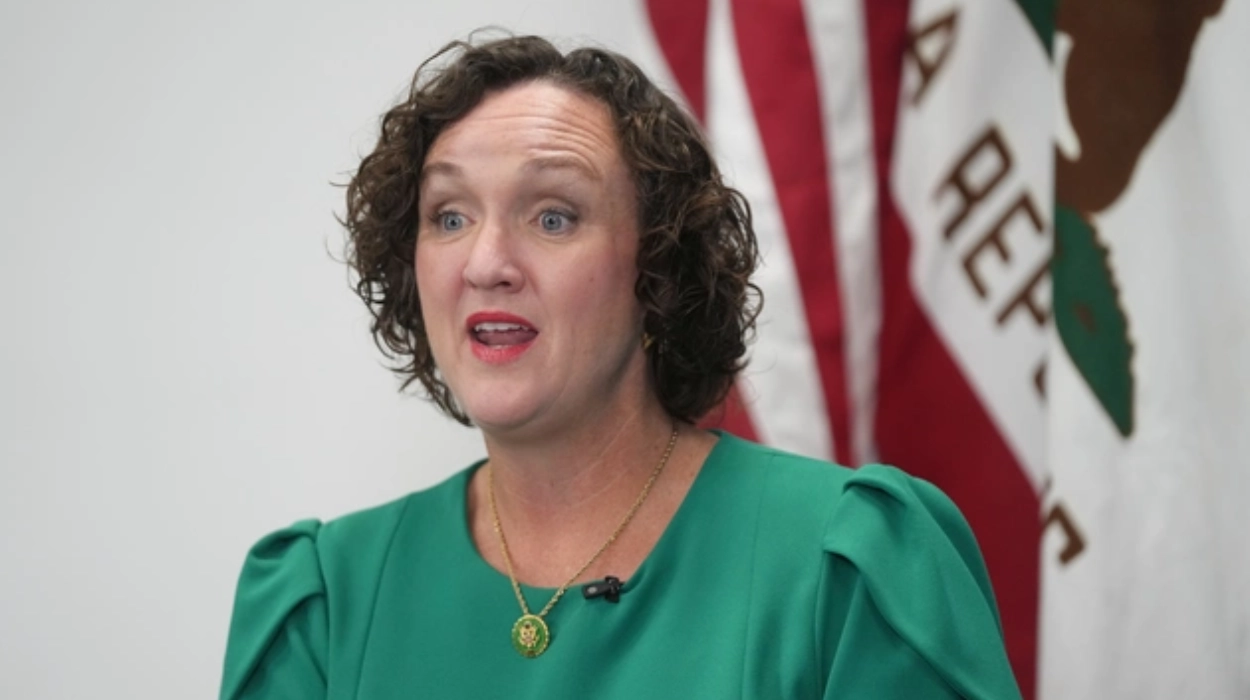

Katie Porter, a former law professor with a background in
consumer protection and bankruptcy law, has risen to national prominence
through her sharp critique of corporate and government officials. She is widely
recognized for bringing a whiteboard with her during Congressional hearings, a
distinctive technique that helped clarify complex financial and policy issues
to the public. Porter’s approach, often involving detailed questioning of CEOs
and officials about corporate practices and government accountability, garnered
viral attention and made her one of the most effective consumer advocates in
Congress. Before entering politics, she taught at universities including
Harvard and University of California, Irvine, shaping her expertise in
financial law and advocacy.
Elected to the U.S. House of Representatives in 2018
representing a politically mixed district in California, Porter quickly
established a reputation for transparency, directness, and a commitment to
middle-class economic interests. Her legislative focus has included affordable
healthcare, consumer protections, and economic equity, aligning closely with
progressive Democratic priorities. Her ability to connect with diverse voters
and address complicated issues in an accessible manner has contributed to her
rising political stature.
Katie Porter’s net worth and financial profile
Katie Porter’s financial standing in 2025 reflects years of
professional labor in both academia and government service. Her reported net
worth ranges broadly between approximately $175,000 and $2.1 million, primarily
accumulated through her Congressional salary, savings, book deals, and real
estate investments. With an official Congressional salary of roughly $174,000
annually, Porter’s income derives
mainly from public service and academic endeavors rather than corporate or
investment wealth, distinguishing her from some political peers. She holds
assets including retirement and savings plans, balanced against liabilities
such as an estimated $300,000 to $600,000 mortgage on her residences.
Porter’s financial profile mirrors her political image as a
transparent, accountable figure focused on fairness and economic responsibility
rather than wealth accumulation. Her approach to money management and public
finances underscores her advocacy for policies aimed at protecting middle and
lower-income families from economic uncertainties.
The 2025 California governor race and Katie Porter’s
candidacy
On March 11, 2025, Katie Porter announced her candidacy for
governor of California in the 2026 election, positioning herself as a leading
contender within the Democratic primary field ahead of Governor Gavin Newsom’s
term limitation. Porter campaigned on pledges to prioritize affordable housing,
healthcare access, climate action, and economic reforms aimed at reducing
income inequality, leveraging her Congressional experience and consumer
advocacy background.
In early October 2025, Porter’s campaign gained considerable
attention following a viral interview with a local Sacramento news reporter.
The exchange, which involved a contentious discussion about winning support
from Republican voters, revealed Porter’s assertive communication style but
also sparked criticism from both political opponents and media commentators.
During the interview, Porter challenged the persistence of the reporter’s
questioning and at one point threatened to end the discussion, later clarifying
her intent and continuing the interaction. This episode provoked polarized
reactions, with some viewing it as a campaign misstep while others saw it as
evidence of Porter’s unwillingness to engage with adversarial questioning
superficially.
Despite this moment, experts note Porter’s strong grassroots
support, name recognition, and policy focus remain assets. She has emphasized
building a broad coalition to win the primary, with a focus on progressive
voters and efforts to expand crossover appeal.
Katie Porter’s advocacy style and the “whiteboard”
phenomenon
One of Katie Porter’s most distinctive political trademarks
is her use of a whiteboard during Congressional committee hearings and public
engagements. This tool enables her to break down complex subjects such as
corporate finances, government budgets, and consumer protections into visual
explanations accessible to a wider audience. The whiteboard technique gained
viral popularity and has become synonymous with her relentless questioning of
officials, adding to her reputation as a tenacious and effective legislator.
Porter integrates this method as part of a broader
communication style emphasizing transparency, accountability, and clarity. It
allows her to hold powerful individuals and institutions to account in a manner
that resonates with constituents and enhances understanding of policy impacts.
The whiteboard approach bridged the gap between legislative processes often
viewed as opaque and public demand for clear explanations of governance and
corporate behavior.
The “whiteboard moments” contribute to her popularity among
progressives and middle-class voters frustrated with economic inequalities and
lack of regulatory oversight, reinforcing her image as a champion for consumer
and worker rights.
Future prospects and political significance
Katie Porter’s candidacy for California governor in 2026
signifies not only a critical milestone in her political trajectory but also
reflects broader currents shaping the Democratic Party and progressive politics
in the United States. Since first gaining national attention as a strong
advocate for consumer rights and economic fairness during her tenure in
Congress, Porter has leveraged her expertise and communication skills to carve
out a distinctive political brand—one that emphasizes accountability,
transparency, and evidence-based policymaking. Her gubernatorial bid envisions
translating her legislative principles into executive action on some of
California’s most pressing challenges, including housing affordability, climate
change mitigation, healthcare access, and social justice reforms. As such, this
campaign embodies both a personal career evolution and reflects larger debates
within the party about the future direction of governance in America’s most
populous state.
Porter’s political style is grounded in direct engagement
and connection with diverse voter demographics, which is crucial given
California’s complex sociopolitical composition encompassing progressive urban
centers, suburban communities, and rural areas with varied economic and
cultural priorities. Her record of championing consumer protections, fighting
corporate abuse, and advocating for middle- and working-class families
resonates strongly with many Democratic constituencies eager for a leader who
prioritizes equity and social welfare. Her unique approach of employing a
whiteboard during Congressional hearings to dissect and expose complex
financial issues has become emblematic of her hands-on, transparent style,
earning her a reputation as a principled and accessible politician. This
connection gives Porter a base of support vital for a statewide campaign.
Should Katie Porter succeed in securing the governorship, it
would mark a significant transition from her role as a federal legislator to a
chief executive with broad policymaking and administrative authority. This
shift not only amplifies her influence but also brings opportunities and
challenges unique to state leadership. California’s political landscape
presents demanding tasks: addressing the ongoing housing crisis, improving a
complicated healthcare landscape, scaling ambitious climate policies to combat
environmental degradation, and advancing economic justice measures aimed at
closing the persistent income and opportunity gaps. Porter’s stated commitment
to data-driven, transparent governance suggests a focus on not only enacting
reforms but also rigorously evaluating policy outcomes. Such methodologies
align with the contemporary push within the Democratic Party to utilize
evidence and technology for effective governance and public accountability.
Beyond California, Porter’s governorship would extend her
political significance onto the national stage. As governor of the most
populous and economically largest state, she would hold a position of
considerable sway in shaping national policy discussions, particularly
regarding climate action, immigration, and economic equity—issues California
often leads on and advocates for federally. Her rise would likely elevate her
as a prominent progressive voice, potentially positioning her for future roles
within or beyond California politics. The governorship offers a platform to
influence party direction, serve as a counterbalance to conservative policies
at the federal level, and contribute substantively to shaping national
Democratic policy frameworks. In this light, Porter’s campaign has attracted
attention not only for its local impact but also for its implications in
national political dynamics.
Nevertheless, the path to the governorship is fraught with
challenges that demand political acumen, coalition-building ability, and
strategic messaging. Porter faces intense competition from other
well-established contenders within the Democratic primary, each vying to
capture the electorate’s confidence across California’s heterogeneous voting
blocs. The intra-party rivalry requires careful navigation of ideological
divides between moderate, centrist Democrats and the more progressive factions
that Porter represents. Expanding appeal beyond her existing core progressives
requires addressing diverse voter concerns, including those relating to economic
growth, taxation, and public safety, and effectively communicating policy
nuances to a broad audience.
Porter’s campaign has also come under scrutiny for moments
of tension in public and media interactions, as evidenced by viral interviews
that have elicited both criticism and support. Managing public perception,
engaging constructively with the press, and maintaining composure under
adversarial questioning are vital in sustaining momentum and building trust
among undecided voters and skeptics alike. Her performance in debates, town
halls, and media platforms will substantially influence public opinion and
could determine the race’s outcome.
Furthermore, California’s complex political and
administrative environment presents governance challenges unique to the state,
with its vast population, economic disparities, and environmental
vulnerabilities. The role of governor demands balancing policy innovation with
pragmatic considerations like budget constraints, legislative cooperation, and
bureaucratic administration. Implementing reforms within such a multifaceted
context requires adept leadership adept at negotiation, coalition management,
and policy prioritization. Success will depend on Porter’s ability to build
partnerships across political lines and integrate stakeholder inputs to advance
comprehensive and sustainable solutions.
Katie Porter’s net worth, while modest compared to many
political figures, reflects a career built on public service and academic
accomplishments rather than private wealth accumulation. This aspect
contributes to her public image as a politician attuned to middle-class
realities and economic fairness. Her transparency in financial disclosures and
commitment to campaign finance reforms further bolster her appeal to voters
concerned about ethical governance and the influence of money in politics.
Katie Porter’s 2026 gubernatorial campaign marks a defining
moment in her evolution from a consumer advocate and Congresswoman to a
potential state leader with broader executive responsibilities. Her progressive
platform, effective communication style, and commitment to evidence-based
policymaking position her as a compelling candidate in California’s competitive
political arena. The stakes are high not only for California’s future but also
for shaping the trajectory of the Democratic Party and potentially the national
political discourse. Navigating the internal party dynamics, public scrutiny,
and the complexities of governing one of the world’s largest economies will
delineate Porter’s leadership arc and political legacy. Beyond the election,
her role could significantly influence policy innovation, social equity, and
political engagement both within California and across the United States.