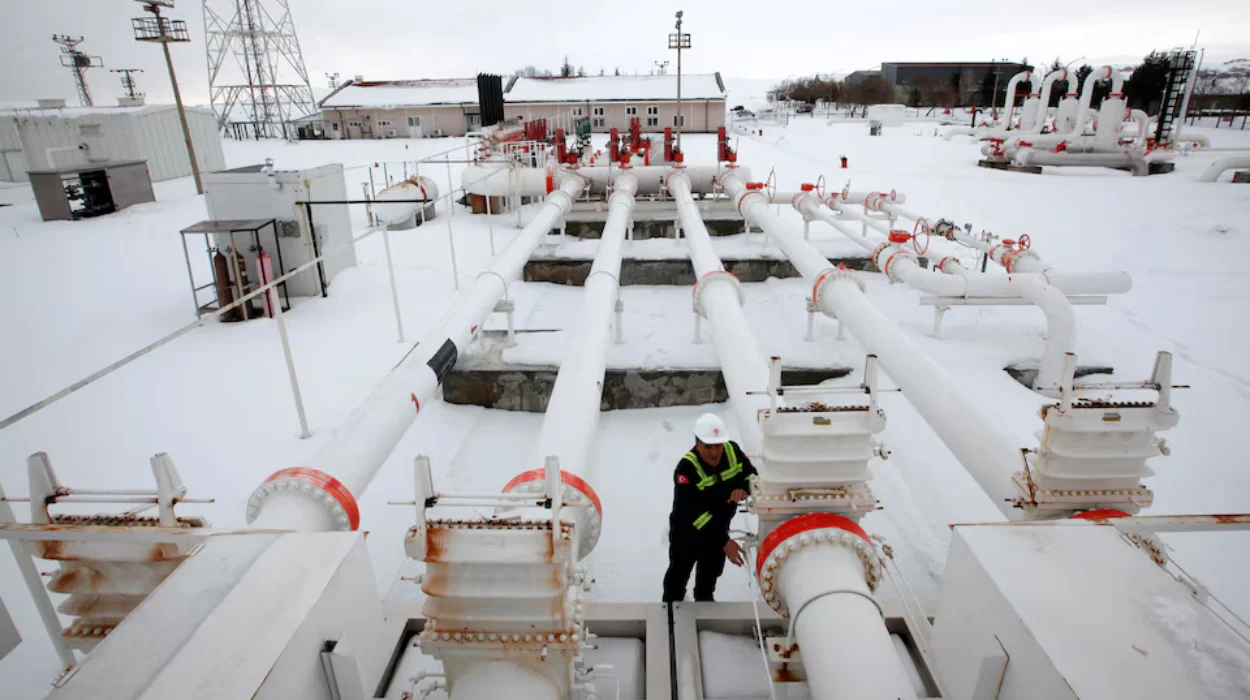

TurkStream is a major natural gas
pipeline that began operation in January 2020, directly connecting Russia to
Turkey across the Black Sea. Spanning approximately 930 kilometers from
Russia’s Russkaya compressor station near Anapa to Turkey’s Kıyıköy terminal on
the European coast, the pipeline features two parallel lines with a combined
annual capacity of 31.5 billion cubic meters (bcm). One line caters to Turkey’s
domestic gas consumption, while the other facilitates the transit of natural
gas to South-eastern and Central Europe through Bulgaria. TurkStream replaced
the inactive Trans-Balkan pipeline route, which for decades had transported
Russian gas via Ukraine, Romania, and other countries into Europe but ceased
following geopolitical conflicts. By establishing this direct route, TurkStream
solidified Turkey’s role as a critical energy hub bridging Russian supply with
European demand, effectively bypassing the politically fraught transit
countries and enhancing energy security for Turkey and its European partners.
The pipeline incorporates advanced
engineering features to withstand Black Sea conditions, including operating at
300 bar pressure, employing 32-inch diameter pipes with thick walls, and
concrete coating for protection. The deepwater installation reaches
depths of up to 2,200 meters (7,200 feet), representing a significant technical
achievement in subsea pipeline construction. TurkStream was constructed at an
estimated cost of €11.4 billion and features a consortium of manufacturers and
operators from Russia, Germany, and Japan. Since its inauguration by Presidents
Vladimir Putin and Recep Tayyip Erdoğan, TurkStream has become central to
Russia-Turkey energy relations, also supporting broader geopolitical
strategies. The pipeline’s operational flexibility enables Russia to maintain
significant gas exports to southern Europe amidst tensions over Ukraine, while
Turkey benefits from secure energy supply and transit fees.
Turkey’s shift in natural gas
sourcing and energy strategy
As of 2025, Turkey is undergoing a
notable energy transition characterized by efforts to diversify natural gas
sources and reduce dependence on Russian and Iranian supplies. Turkey’s natural
gas consumption continues rising with economic growth and household demand,
prompting strategic diversification. According to recent reports, Turkey
expects to meet more than half of its gas demand by the end of 2028 through
increased domestic production and expanded liquefied natural gas (LNG) imports,
primarily from the United States. This reduction in reliance on Russian
pipeline gas via TurkStream and Iranian imports represents a strategic pivot to
enhance energy security, supply flexibility, and geopolitical autonomy.
Despite this shift, TurkStream
remains a significant gas conduit for Turkey and regional gas markets, as gas
flows have surged, with Gazprom reporting a 23% increase in throughput in early
2025 reaching more than 16 bcm. The pipeline preserves a critical supply link
to Southeastern Europe, which continues to depend on Russian gas amid broader
European energy tensions. Nonetheless, Turkey’s import strategy incorporates increased
LNG shipments, storage expansions, and investment in renewables, reflecting a
multi-pronged approach to energy resilience. This strategic diversification
manifests Turkey’s balancing act between maintaining traditional energy
partnerships and adapting to evolving geopolitical constraints and market
opportunities.
Geopolitical and economic
implications of TurkStream
TurkStream holds substantial
geopolitical significance involving Turkey, Russia, and European nations. The
pipeline fortifies Turkey’s position as an indispensable energy transit hub
connecting Russian resources to the European market while positioning Turkey as
a geopolitical mediator amid east-west tensions. Following the 2014
cancellation of the South Stream pipeline and subsequent escalation of
Russia-West conflicts over Ukraine, TurkStream emerged as Moscow’s prioritized
export channel circumventing Ukraine, downscaling Kyiv’s transit influence and
revenues. For Turkey, the pipeline strengthens economic ties with Russia,
fosters energy security, and generates substantial transit income.
Economic impacts extend to
Turkey’s refining sector, which benefits from increased access to Russian crude
and refined products transiting through the Turkish Straits, yielding cost
advantages and expanded export capabilities. This intertwining of energy
infrastructure and geopolitics illustrates complex interdependencies where
Turkey leverages geographic advantages while navigating alliance pressures.
European consumers dependent on TurkStream deliveries face risks related to
geopolitical disputes, sanctions, and supply volatility, prompting debates on
energy diversification and resilience. The pipeline also exemplifies how large
infrastructure projects serve broader state interests beyond energy commerce,
including military strategy and regional influence.
Technical specifications and
operations of TurkStream
TurkStream consists of two
parallel underwater pipelines constructed using high-strength steel pipes
manufactured in Germany, Russia, and Japan. The first pipeline delivers gas
directly to Turkish markets, while the second pipeline extends exports to
Bulgaria and potentially other southern and central European countries. The
pipelines have an outer diameter of 810 millimeters (32 inches) and a wall
thickness of 39 millimeters (1.5 inches), designed to endure high internal
pressures of approximately 300 bars (4,400 psi) and external stress conditions
across deep-sea environments.
The system employs sophisticated
compressor stations near the Russian coast to maintain consistent pressure and
flow rates, ensuring an efficient and reliable supply that meets peak demand
periods. The underwater route of the pipeline traverses a diverse seabed
topography within the Black Sea, requiring careful engineering to mitigate
risks from sediment movement, seismic activity, and corrosion. The concrete
coating of 80 millimeters (3.1 inches) protects pipes from mechanical damage
and marine elements. The completion of TurkStream marked a significant
milestone in Russia’s strategy to modernize its gas export infrastructure and
bypass traditional transit countries.
Prospects and challenges ahead for
TurkStream and Turkey’s energy future
Looking forward, TurkStream serves
as a dynamic artery in Turkey’s evolving energy landscape but faces both
opportunities and challenges. Increased competition from LNG imports, growing
domestic renewable energy initiatives, and geopolitical changes will influence
TurkStream’s role and throughput in coming years. Turkey’s commitment to
reducing Russian and Iranian gas dependence signifies a strategic transition
toward diversified and sustainable energy sources, yet TurkStream is expected
to remain a vital component of the regional gas supply chain due to existing
infrastructure and contracts.
Challenges include potential
disruptions from regional conflicts, sanctions regimes targeting Russian energy
exports, and technical maintenance of the aging pipeline infrastructure. Market
fluctuations and global energy price volatility also affect operation economics
and investment decisions. Nevertheless, ongoing investments in energy
interconnectors, storage facilities, and strategic reserves complement
TurkStream’s utility, positioning Turkey as a key energy corridor bridging East
and West.
TurkStream is a state-of-the-art
cross-Black Sea pipeline providing Russia-origin gas supplies to Turkey and
Southern Europe. Its construction solidifies Turkey’s energy dependencies and
geopolitical strategies while Turkey actively pursues diversification to
enhance security and resilience. The pipeline’s technical excellence
underscores its strategic value, but shifting political and market conditions
will define its future significance in the regional energy domain.