
Key Points
- · President
Donald Trump authorised 300 National Guard troops to be deployed to Chicago
amidst rising concerns over violent protests and lawlessness related to
immigration enforcement. - · The
deployment comes after federal immigration agents shot an armed woman during
protests outside ICE facilities in Chicago. - · Illinois
Governor JB Pritzker strongly opposed the federal deployment, calling it
“outrageous” and an overreach of authority. - · The White
House justified the deployment as necessary to protect federal officers and
properties due to local authorities’ failure to control violent riots. - · A federal
judge has blocked a similar troop deployment plan in Portland, Oregon, citing
constitutional concerns. - · The legality
of deploying National Guard troops without state governor consent is disputed,
raising constitutional questions. - · The woman
involved in the shooting reportedly drove herself to hospital and her injury
extent is unclear. - · Governor
Pritzker warned that the deployment would disrupt Illinois citizens and is more
about control than public safety. - · The
Department of Homeland Security reported the shooting was a defensive response
to an armed motorist allegedly ramming law enforcement vehicles. - · The White
House did not specify whether troops came from the Illinois National Guard or
other states.
What was the reason for
President Trump’s National Guard deployment to Chicago?
As reported by Abigail Jackson,
White House spokesperson, the deployment of 300 National Guard troops to
Chicago was authorised in response to ongoing violent riots and disorder
affecting federal immigration enforcement operations in the city. Jackson
stated, “President Trump will not ignore the lawlessness afflicting
American cities,” emphasising the necessity to protect federal officers
and properties. This decision followed a recent incident where a federal
immigration agent shot an armed woman after demonstrators reportedly rammed
vehicles into immigration enforcement units in Chicago’s Brighton Park
neighbourhood.
The Department of Homeland
Security (DHS) further clarified that law enforcement personnel were boxed in
by approximately 10 vehicles, one of which was driven by a semi-automatic
weapon-armed individual, forcing agents to fire defensively. Despite the
severity, the woman managed to drive herself to hospital. DHS assistant
secretary Tricia McLaughlin criticised local Chicago police for reportedly
abandoning the shooting scene and neglecting to secure the area adequately.
How did Illinois Governor JB
Pritzker react to the troop deployment?
Illinois Governor JB Pritzker
vehemently opposed the deployment, calling it “absolutely outrageous and
un-American” to force military troops into the state without the
governor’s consent. Pritzker described the action as a “manufactured
performance” rather than a genuine safety measure, accusing the Trump
administration of using military resources as a tool for political control
rather than public safety. Pritzker disclosed that the Department of Defense
issued an ultimatum to the state, demanding that the governor either call out
the troops himself or have them federalized by the Pentagon.
Pritzker also highlighted the
disruption the deployment would cause to the lives of Illinoisans, pulling
hardworking National Guard members from their jobs and families to participate
in what he described as a staged political manoeuvre. He and other state
leaders framed the deployment as a clear overreach of federal power and a
provocation aggravating an already tense situation.
What legal and constitutional
issues are involved in the deployment?
As noted by Judge Karin
Immergut in Portland, Oregon, the federal administration’s plan to deploy
troops without state approval jeopardises state sovereignty and blurs the lines
between military and civilian federal authority. While Portland’s case resulted
in a court order temporarily blocking troop deployment, Chicago is expected to
face similar legal challenges. The longstanding regulations typically restrict
federal military involvement in domestic law enforcement, reserving National
Guard control to state governors except in extraordinary circumstances.
Illinois Attorney General Kwame
Raoul expressed commitment to defending the Constitution and pursuing legal
action if the deployment violated state laws or authority. The growing number
of such federal deployments in Democratic-led cities—Washington, Los Angeles,
Memphis, Portland, and now Chicago—raises serious constitutional questions
about the balance of federal and state powers.
What events led up to the
deployment order on Saturday?
Earlier on Saturday, federal
immigration officials involved in Operation Midway Blitz faced escalating
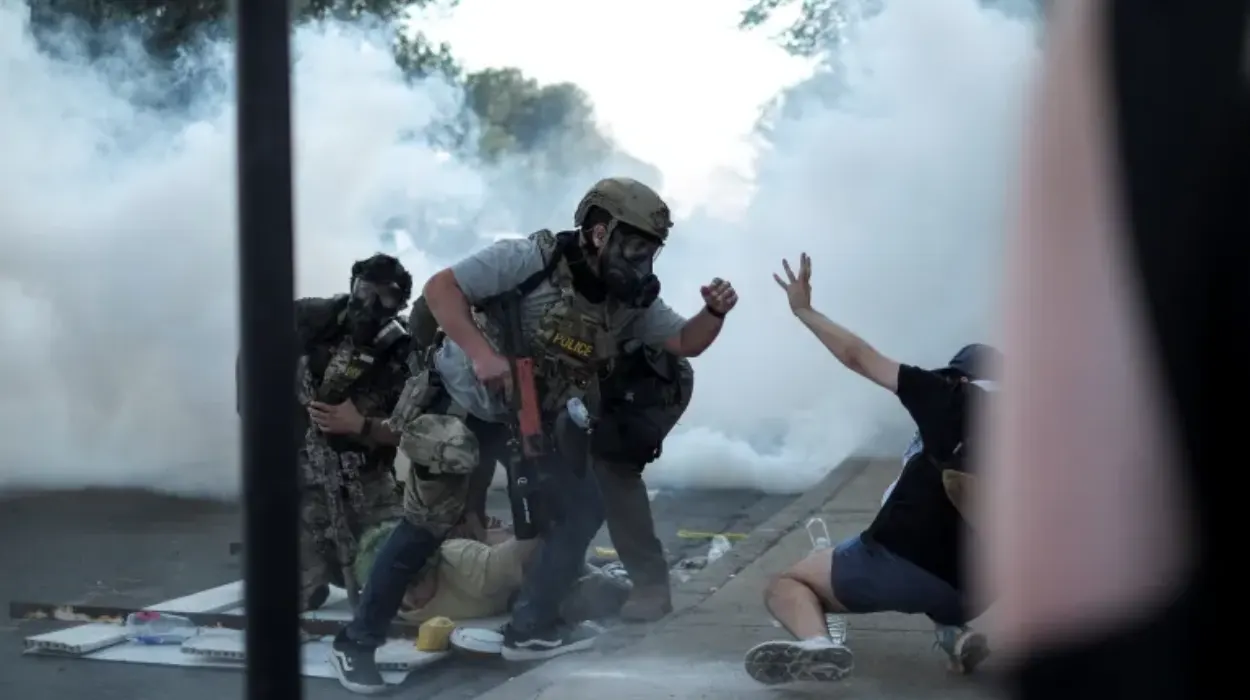
protests outside ICE facilities in Chicago. Demonstrators allegedly rammed
vehicles into enforcement units, leading to an armed female motorist being shot
during a confrontation. Following the incident, protests intensified, with
federal agents responding using flash-bang grenades and tear gas amid reports
of demonstrators throwing water bottles.
This volatile atmosphere pushed
the White House to expedite deployment plans meant to safeguard federal
officers involved in immigration enforcement. Despite President Trump’s
previous public criticism of Chicago and Governor Pritzker over crime and
safety issues, this marked a direct federal intervention in the city’s law
enforcement landscape.
How has the White House
characterised cities like Chicago politically and in terms of safety?
President Trump has
consistently portrayed Democratic-led cities such as Chicago as unsafe and
“lawless.” As recently as early October 2025, Trump referred to
Chicago in social media posts portraying it as a focal point for disorder and
crime, framing the deployment as part of an effort to restore law and order.
According to reports, Trump discussed using city deployments as “training
grounds” for troops to tackle the “enemy from within” and emphasised
a strong stance on law enforcement in opposition to what he described as local
leaders’ negligence.
White House statements
emphasise that this deployment is part of a broader national strategy to curb
rising urban unrest connected to immigration enforcement crackdowns. Critics
argue, however, that the federal approach exacerbates tensions and politicises
law enforcement.
What are the differing
perspectives on the shooting incident involving the armed woman?
According to Homeland Security
officials, the shooting was a defensive action following an armed woman ramming
immigration agents’ vehicles. However, activists dispute this account, claiming
immigration enforcement agents crashed their vehicle into a civilian car,
prompting the shooting. The woman was reportedly not seriously injured and
managed to reach hospital care by herself. These conflicting narratives further
fuel the protests and criticisms of federal enforcement practices in Chicago.
What is the current status of
National Guard troop deployment to Chicago?
While President Trump
authorised the deployment and Illinois Governor Pritzker condemned it, it
remains unclear if the troops have physically arrived in Chicago or if the
deployment is being executed through federalisation of the Illinois National
Guard. The White House has not clarified whether personnel will be drawn from
Illinois or other states. The situation remains dynamic, with legal and
political challenges expected to continue.