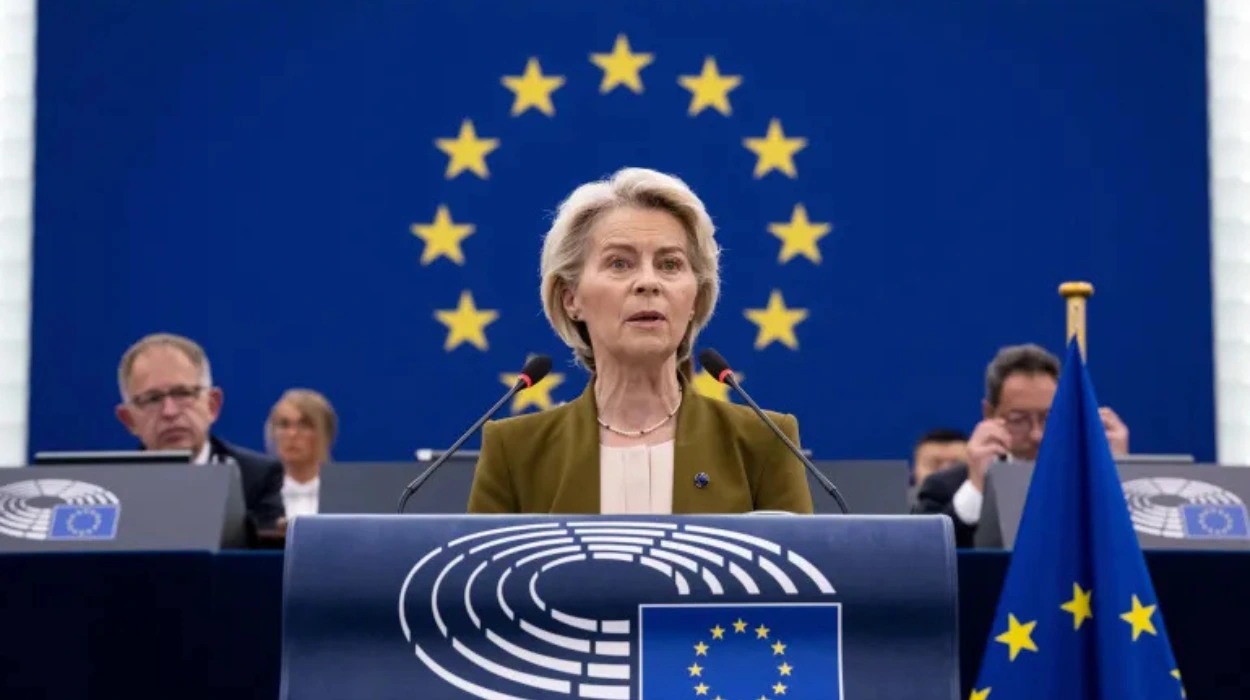

European Commission President Ursula von der Leyen has vowed
to take decisive action aimed at halting Israel’s ongoing military campaign in
Gaza, signaling a pivotal moment in the European Union’s stance on the
conflict. Speaking during the annual State of the Union address in Strasbourg
on September 10, 2025, von der Leyen described the humanitarian situation in
Gaza as “catastrophic” and outlined plans for a comprehensive package
of measures targeting Israel’s policies.
Von der Leyen declared,
“What is happening in Gaza is unacceptable. Man-made
famine must stop for the sake of humanity and our children.”
She underscored the EU’s growing impatience with the
deteriorating humanitarian conditions and emphasized the bloc’s responsibility
to lead on this urgent issue.
Her announced response includes sanctions directed at
extremist Israeli ministers and violent settlers, as well as a proposal to
suspend essential aspects of the EU-Israel Association Agreement, which
currently grants Israel preferential trade access within the European market.
Sanctions and Trade Suspension Proposals
The package of measures that von der Leyen outlined aims to
freeze bilateral support for Israel and impose sanctions on individuals deemed
responsible for escalating tensions and human rights violations. The European
Commission intends to target extremist ministers within Prime Minister Benjamin
Netanyahu’s government, particularly those associated with far-right factions
driving settlement expansion in the occupied West Bank.
In practical terms, this could include the suspension of
selective trade privileges granted to Israel under the Association Agreement,
potentially impacting billions in Israeli exports to the EU, including
agricultural products like dates and citrus fruits.
Von der Leyen stressed,
“Europe needs to do more. We cannot turn a blind eye to
violations of human rights and democratic values.”
She further called for unity among EU member states, warning
that member countries must also accept their own responsibilities to act
decisively.
Diplomatic and Internal EU Challenges
Despite the Commission President’s firm stance, the proposed
sanctions and trade suspensions face significant diplomatic hurdles within the
EU. Member states hold divergent views on how hard to pressure Israel, with
some like Germany and Italy expressing caution, while countries such as Ireland
and Spain advocate for stronger punitive actions.
EU foreign policy chief Kaja Kallas acknowledged these
divisions, stating,
“Political divisions within the European Council remain
largely unchanged. Yet we must find a strong voice grounded in our values and
principles.”
The challenge remains to build consensus for these
unprecedented measures, especially as they require a qualified majority for
trade suspensions and unanimous approval for individual sanctions.
Criticism from Israel
The Israeli government swiftly condemned von der Leyen’s
proposals, with Foreign Minister Gideon Saar accusing the EU of unfairly
singling out Israel. Saar took to social media to say,
“These regrettable statements amount to supporting
Palestinian militant groups, including Hamas. The European Union’s actions are
sending the wrong message and embolden terrorism in the region.”
Saar emphasized Israel’s ongoing efforts to address
humanitarian issues in Gaza and blamed Hamas for the suffering, reinforcing
Israel’s narrative that its military operations are a necessary response to
terror threats.
EU’s Humanitarian Commitments and Broader Middle East Policy
Alongside punitive measures, the European Commission
announced plans to establish a Palestine Donor Group next month aimed at
mobilizing resources for Gaza’s reconstruction. Von der Leyen called for an immediate
ceasefire and unimpeded access for humanitarian aid, insisting that
hostages held by Hamas be freed without delay.
She remarked,
“Our goal is clear: peace and a safe future for all
Israelis and Palestinians. Europe has always championed a two-state solution
and must now lead the way toward achieving it.”
The EU’s renewed engagement develops amid growing public
pressure and widespread protests across Europe, demanding governments address
what many view as disproportionate Israeli military action in Gaza. The United
Nations has classified the humanitarian crisis in Gaza as a potential genocide,
which has deepened calls for urgent international intervention.
Legal Basis for EU Actions
The Commission’s proposals rely on the legal framework of
the EU-Israel Association Agreement, specifically Article 2, which requires
respect for human rights and democratic principles. The European Commission
concluded that Israel’s recent actions, including military offensives in Gaza
and settlement expansion, constitute violations justifying a partial suspension
of the agreement.
This is a rare and significant move, marking a sharp
departure from the EU’s traditionally cautious approach to Israel, reflecting
growing frustration within Europe at the ongoing conflict’s toll on civilians.
Political Implications and the Road Ahead
Von der Leyen’s speech represents a defining moment for the
EU’s Middle East policy, signaling an intention to transition from diplomatic
rhetoric to more assertive economic and political tools. However, the
likelihood of full approval of the sanctions and trade limitations remains
uncertain amid internal EU disagreements.
Foreign ministers meeting in Copenhagen earlier in September
grappled with this complexity, balancing solidarity with Israel against the
imperative to address humanitarian catastrophes.
Adham Sahloul, a former adviser in the Biden administration,
commented,
“Israel’s current course risks alienating regional
allies and undermines its standing as a committed partner for peace.”
As the EU navigates this critical juncture, its actions will
reverberate globally, shaping international response to the Israel-Gaza
conflict and testing the resolve and unity of the bloc itself.