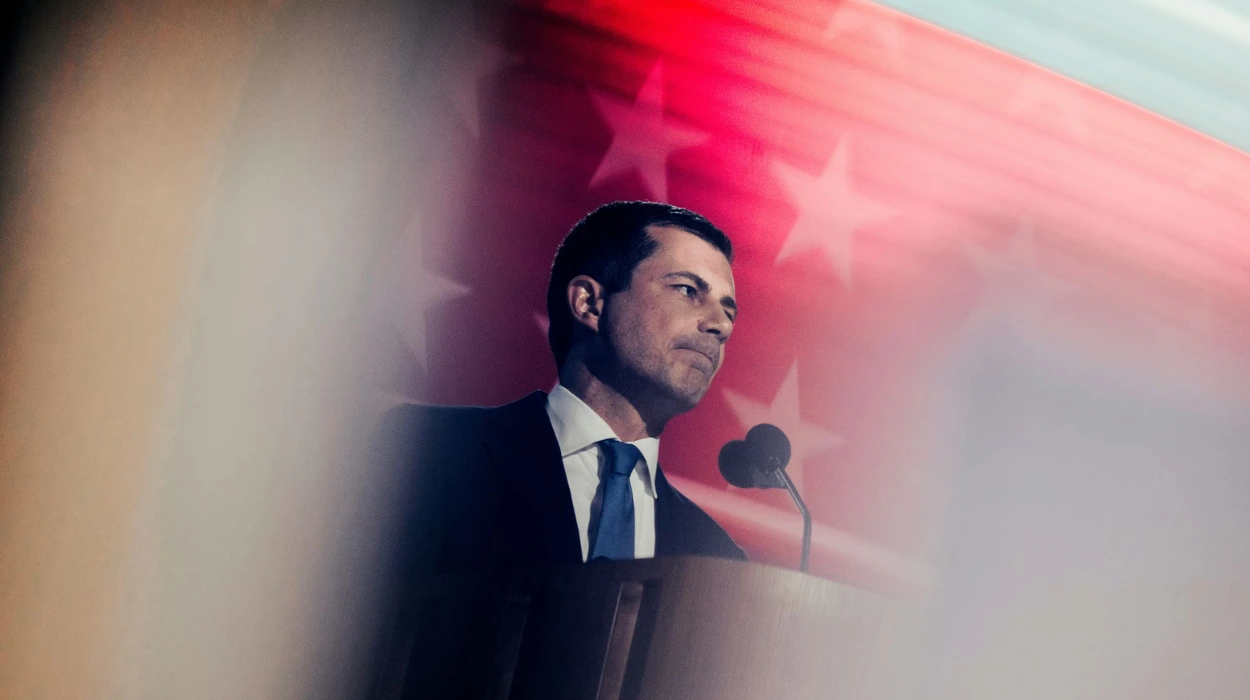

Peter Paul Montgomery Buttigieg, born on January 19, 1982,
is an American politician who first gained recognition as the mayor of South
Bend, Indiana from 2012 to 2020. During his time as mayor, Buttigieg gained
national recognition and admiration as one of the youngest mayors of a U.S.
city, known for his commitment to urban revitalization and inclusivity.
Buttigieg’s political career took off during his candidacy for the Democratic
nomination for President of the United States during the 2020 election. While
he did not win the nomination, his campaign was noted for its message around generational
change and progressive agendas. After the election he served as U.S. Secretary
of Transportation in President Joe Biden’s cabinet from 2021-2025 in which he
oversaw the Department of Transportation working on infrastructure investment
and climate change. Following his tenure as Secretary from 2022-2025 and
afterwards, Buttigieg has been reportedly thinking through a presidential run
in 2028 while reserving a run for U.S. Senate or Governor of Michigan.
Buttigieg’s increased visibility and fundraising presence has made him
potentially a rising star within the Democrats.
Pete Buttigieg’s personal life and family
Pete Buttigieg is married to Chasten Glezman, a
schoolteacher and writer whom he wed in June 2018. Their relationship and
marriage have received public attention, partly because Buttigieg was the first
openly gay major presidential candidate in the United States, breaking
significant barriers in American politics.
The couple is known
for their openness about their family life, including their experience raising
twins born in 2021, balancing public service with parenting responsibilities.
Chasten has supported Pete’s political career, engaging actively in education
and advocacy efforts. Their family life has often been highlighted in the media
as a symbol of changing social norms and greater acceptance. Describing
themselves as devoted parents, they often share experiences aiming to inspire
diverse family dynamics within political and social discourse.
Net worth and financial standing
Pete Buttigieg’s net worth has grown alongside his political
career and public service. Although estimates may vary, Buttigieg’s net worth
is cited as being in the multi-millions based on his public salaries, speaking
fees, book advances, and consulting work. As mayor of South Bend, Buttigieg had
a reasonably modest salary in comparison to salaries for federal officeholders,
but as Secretary of Transportation, serving under the Biden administration, his
earnings have substantially increased. Additionally, post-government work that
involves media appearances, writing, and eventually advisory work have
positively impacted Buttigieg’s financial picture. Buttigieg’s financial
disclosures meet the transparency requirements for federal officials, and his
net worth level is consistent with decades of public service and a growing
national profile.
Pete Buttigieg’s previous offices and responsibilities
Before he assumed the role as Secretary of Transportation,
Buttigieg was primarily an elected official as mayor of South Bend, elected in
2011 and assumed office in 2012 and served through 2020. He is remembered for
his efforts to revitalize the economy, infrastructure, and public services
during his years as mayor. During this time as mayor, Buttigieg is known for
fostering a more inclusive political climate that engaged segments of the
community who would not typically participate in the political process, regardless
of the socio-economic demographic. He also served in the U.S. Navy Reserve
during his time as mayor and was deployed to Afghanistan, lending legitimacy to
his leadership. After his experience as a presidential candidate, he was
confirmed in the role of Secretary of Transportation, where he has focused his
work on modernizing the nation’s infrastructure, integrating climate policy
into transportation and promoting equity in federal transportation planning.
His leadership has strengthened and expanded the visibility and leadership of
the department to advance the Biden administration’s priorities.
The Kamala Harris snub and political dynamics
The connection in her political relationship with former
Vice President Kamala Harris and with Pete Buttigieg has caused much
speculation, especially with the events following the 2024 U.S. presidential
election. These are two important leaders in the Democratic Party, and their
political relationship illustrates the intricate nature of intra-party
competition and political decision-making during the tumult of political
regeneration. Harris, a trailblazer as the first Black and South Asian-American
woman elected vice president, has been positioning herself in the political
landscape for a competitive future in the party, including a gubernatorial
future project in California. Buttigieg, former mayor of South Bend and
Secretary of Transportation in the Biden administration, has similarly been
building upon his past presidential ambitions for 2028 and accounts of the vice-presidency
process.
One significant episode that highlights the nature of their
political relationship takes place in Harris’s recent memoir “107
Days,” where she discusses her vice presidential selection process during
the 2024 election cycle. In her memoir Harris recounts that Buttigieg was her
first objective selection for vice-president, referring to him as a
“sincere public servant” with the ability to speak about liberal
policies using words which could be understood by a conservative demographic,
qualities that are significantly endowed with importance in a competitive
political environment.
Despite her appreciation, Harris has reported feeling
uncomfortable with her choice of Buttigieg given the concerns of the public on
a historic ticket where a Black woman would be advanced with an openly gay man
like Buttigieg. Harris indicated the uncertain electoral risks of such a
partnership given the already polarized public around running against a sitting
president of the Republican Party and conceived strong opposition.
This reasoning provoked much public and political dialogue.
Harris’s reasoning involved the supposed unknown risks of electing Buttigieg as
an openly-gay man and in the name of practical electoral calculus to find every
way to maximize electability in what is projected to be a competitive political
competition.
However as it applied to LGBTQ+ concerns and for progressive
commentary, it provoked backlash and reinvested many into affirm that rejecting
Buttigieg for his sexual orientation to be regressive representation, seeing an
approach which suggests extreme caution as an antiquated view in an era of
fostering representation. She added that she has always supported LGBTQ+
rights, and her comment was strategic, not biased in the extraordinary election
that would ensue on it.
Buttigieg was shocked by Harris’s revelations and thought
Americans deserved more credit for their openness to candidates who did not fit
conventional molds. He said that his own political accomplishments, such as
helping make Indiana blue for the first time in decades, indicated that voters
were generally much more concerned about the results of public policy outcomes
than about identity-based markers.
The political distancing Harris and Buttigieg observe
between each other within the party can also be seen as part of traditional
jockeying for influence and leadership in a major party going through some
post-election soul-searching process. Both have advanced during a time when
Democrats need to redefine the meaning of the Democratic Party and unify their
coalition after losing to Donald Trump and newly-elected Vice President JD
Vance ticket in the 2024 election. Harris’s potential candidacy for governor in
California positions her as a potential power broker in the all-important
state. But Buttigieg has garnered attention during his time as a male national
figure and a good communicator potential future national candidate based on his
growing profile as a national leader which could imply he intends to use his
mass appeal for longevity and possibly a future presidential run. Their
competition for the future of the party could inevitably create alignments and
even a degree of distance while they both seek a pathway forward in states
where they want to lead different factions of the party’s coalition of
constituents.
Moreover, this interaction speaks to the broader and deeper
issues within the Democratic Party to navigate the ideals of diversity and
representation alongside electoral practicality and viability. Together,
Harris’s decision and the reactions highlight the difficulties of running a
coalition of identities while trying to appeal to a wider electoral base. The
balancing act that any major party must struggle with is that there must be
historic (and yes, historic) moments of inclusion, potentially having a Black
woman and an openly gay man on the same national ticket, in direct and explicit
opposition to voter hesitations or biases that might exist in parts of the
electorate. These tensions will continue to create challenges to the Democratic
Party’s decision-making related to strategic calculus and candidate
endorsements in the next presidential election cycle concerning the 2028
election.
The reported snub between Harris and Buttigieg captures a
moment of political significance that is framed in a complex way with race,
identity, strategy, and ambition. It serves as a case study of how leading
figures of a major political party manage the nuances of personal
relationships, public perception, and electoral realities in the pursuit of
their exercised positions. The interactions Harris and Buttigieg share will
continue to shape Democratic Party dynamics moving into the next presidential
cycle and will be representative of existing tensions and conversations of
diversity, electability, and the questions of the leadership of the Democratic
party going forward.