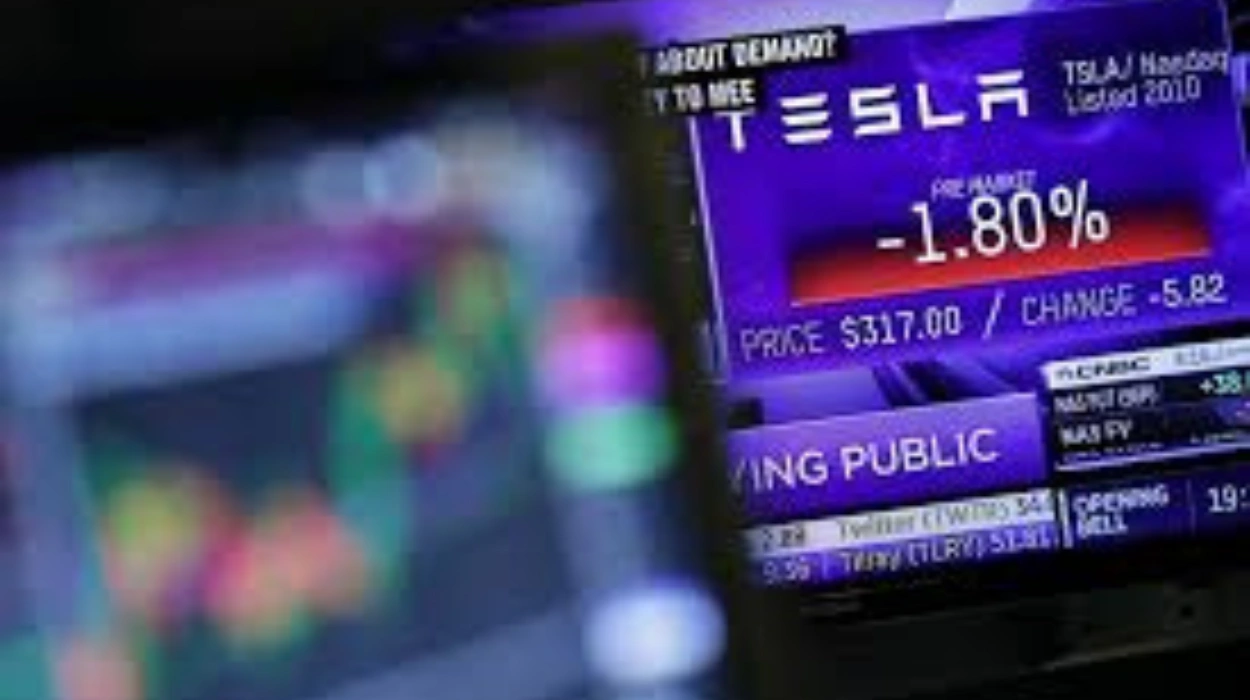

Tesla, Inc. is a worldwide leader in electric vehicle
manufacturing and sustainable energy solutions. By 2025, Tesla has become one
of the most widely owned and widely followed stocks in the world, surpassing a
market capitalization of $900 billion. Who owns Tesla stock is important to
understanding the company’s corporate structure and how its valuation is
derived.
Elon Musk, the company’s CEO and a critical figure in the
company’s success and rise, is still the largest individual holder, but only
holds about 15% of Tesla’s outstanding shares. Musk’s stake of a little over
15% of Tesla represents approximately 506 million shares, indicating
significant influence within the organization, but dispelling any notion that
Musk owns or controls the company wholly. Overall, aside from Musk, the vast
majority of Tesla stock, approximately 80%, is held by institutional and retail
shareholders. Notable institutional shareholders include asset management firms
like Vanguard Group (about 7.79%), BlackRock Advisors (about 4.9%), and State
Street Corporation (about 3.5%). Collectively, these institutions hold many
shares and carry out substantial voting rights and a consequential power to
influence the company’s governance through elections of the board of directors
and important decisions.
Retail investors account for a meaningful fraction of Tesla
shares, reflecting the company’s popularity among individual investors
attracted by Tesla’s growth story and vision of sustainable transportation.
Company executives and insiders hold approximately 13% to 15% of the shares, a
higher rate than traditional automakers, underscoring Tesla’s culture of
ownership among top management and reinforcing alignment with shareholder
interests.
Tesla’s initial public offering (IPO) was in 2010 at $17 per
share. An investment of $1,000 at the IPO price would have grown exponentially;
Tesla’s stock experienced multiple splits (notably a 5-for-1 split in 2020 and
a 3-for-1 split in 2022), which amplified the total number of shares held by
original investors. Today, that $1,000 IPO investment is estimated to be worth
over $450,000, reflecting the company’s remarkable growth trajectory and its
sustained stock market performance even amid volatility and economic cycles.
Is Tesla stock a buy or sell?
Tesla’s stock remains a subject of broad debate among
investors, analysts, and market watchers. The decision to consider Tesla as a
buy or sell depends on various factors including market conditions, valuation
metrics, and investors’ risk tolerance. As of 2025, Tesla trades with a
price-to-earnings (P/E) ratio significantly above that of more traditional
automakers, reflecting high investor expectations for continued growth,
innovation, and expansion across automotive and energy sectors.
Bullish arguments to buy Tesla stock are the company’s
market dominance in electric vehicles, continued innovation in battery
technology, ramping up manufacturing with gigafactories in multiple countries,
and initiatives to accelerate energy investments and software capabilities like
autonomous driving. Of course, I need to acknowledge brand loyalty, which I
believe is a big part of Tesla’s continuous customer base, and innovative
leadership, which in many cases identifies as Elon Musk, when discussing a sustained
level of investment from investors.
On the flip side, many investors express caution due to
Tesla’s overvaluation relative to earnings, uncertainty in macroeconomic
conditions such as inflation and rising interest rates, increased competition
from legacy OEMs as EV competitors as well as EV start up manufacturers,
regulatory risk, and an inherent risk associated with the company itself.
Product recalls, production difficulties, and CEO Musk’s other business
ventures all add layers of risk and volatility to an already volatile company.
As a whole, however, the evaluations of Tesla will oscillate. For example, some
analysts will recommend buy, hold, or sell positions based on either technical
or fundamentals.
Retail investors are often encouraged to diversify and keep
a risk-based mindset when dealing with Tesla stock. Due to the volatility of
the automotive and Technology sectors along with the growth risks that are
unique to Tesla, I encourage each investor to focus on figuring out what is
best for their individual situation based on their own financial goals.
Has Warren Buffett bought Tesla?
Frequent questioning and speculation as to whether Warren
Buffett, famous investor at Berkshire Hathaway has purchased Tesla stocks. That
remains not substantiated in official documents. The 13-F filings with the SEC
and its contents of Buffett’s portfolio with Berkshire, have received a lot of
media attention, but as if the close of 2025 should single out anything
obvious, it’s that there are no Tesla stocks within the holdings of Berkshire
Hathaway that exist in official records, and if beef or stock stuff isn’t any
guess it’s that Buffett has been outspoken about the auto industry being
‘capital intensive and fiercely unpredictable’.
Furthermore, even though Buffett has mentioned Elon Musk got
vision on a few occasions in various contexts, his firm Becker has other large
positions in traditional legacy automobile companies exposed, however, like GM
and Ford, but not Tesla. Sources of Buffett purchasing Tesla shares have
usually been on ‘rumors’ and ‘unverified news’ around it as well as discussions
with no proof that these disclosures exist or transpired. Therefore, for now
there isn’t proof or evidence that would suggest Buffett or Berkshire Hathaway
has purchased on the stock of Tesla.
Tesla’s profitability and financial performance
Tesla’s profitability has always been a hotbed of activity
due to its significant capital outflow in terms of product development, factory
expansions, and new technology development. For many years after its IPO, Tesla
reported net losses due to its large fixed costs. But by the early 2020s, Tesla
began reporting consistent quarterly net profits based on improved production
efficiency, incremental increases in vehicle deliveries, and continued
increases in revenue from its energy and software services vertical.
Tesla reported trailing twelve-month revenue of more than
$97 billion in 2024, as well as gross profits of nearly $17.5 billion. Revenues
generated from vehicle sales, energy generation and storage systems, and its
proprietary software including subscriptions for its Full Self-Driving package,
allowed Tesla to develop a mix of revenue streams. This multi-faceted approach
has allowed Tesla to sustainably improve its margins, even in light of fierce
competition.
Most recently, while acknowledging some macroeconomic
headwinds (broadly impacting the auto and tech industries) Tesla’s
profitability continues to outperform where contemporaneously reported
(management discussion) and where they would otherwise reasonably expect it
would be. Management has indicated their general trend towards margin
improvements through scale and innovation as competition continuously pressures
this aspect of their business model. Analysts are watching Tesla’s continued
capacity to maintain profit growth under supply chain constraints and
heightened regulatory requirements around safety and emissions worldwide.
Elon Musk and Tesla ownership
Elon Musk, while the largest individual shareholder of
Tesla, Inc., has never owned it completely. In 2025, Musk’s ownership stake in
Tesla is estimated to be 12.8% to 15.7%, with the most recent reliable
estimates around 13%. The percentage ownership has changed drastically over the
years due to several financing rounds, multiple stock splits, and very large
sales of shares. Significantly, Musk sold considerable amounts of stock during
2021 and 2022 to finance other activities such as SpaceX and buying Twitter
(now X), which took away from his total shareholding. But his holding—around
410 million shares—still represents a massive holding for the largest single
ownership stake in Tesla’s publicly-traded shares.
It is important to realize the majority of the stock
ownership of Tesla is not Elon Musk having a majority ownership in a privately
held company, but a publicly-traded company that has a very wide and dispersed
ownership (publicly-held stock identification). Other than Musk’s shares, the
great majority of remaining stock ownership is by institutional investors,
retail investors, and other company insiders not including the CEO. Among the
institutional investors there are large investment companies such as Vanguard
and Blackrock. Retail shareholders—ordinary day-day owners of Tesla—trading
Tesla on major stock exchanges, also make up a significant part of the
ownership mix, lending support for the significant popularity of Tesla among
individual investors.
While Musk’s ownership percentage does not confer absolute
control in a literal sense, his influence over Tesla’s strategic direction
remains extremely potent. As CEO and Chief Product Architect, Musk’s leadership
and vision continue to shape Tesla’s innovations, business ventures, and
corporate culture. His voting power is augmented by board membership and
special shareholder agreements that enable him to assert outsized influence in
governance matters, a common arrangement among founder-led companies. His
direct involvement in major product developments like the Tesla Model 3, Model
Y, battery technology improvements, and autonomous driving software establishes
him as the visionary leader driving Tesla’s strategic initiatives forward.
Although the public often views the company’s success as
being entirely due to Musk’s leadership, there are checks and balances in place
to create some oversight, and some accountability from an independent board of
directors and millions of different shareholder interests. Tesla’s board
consists of independent directors, along with some senior executives who,
together review performance, have fiduciary responsibilities, and appear to
provide risk oversight of Musk’s leadership. While Musk’s direction is necessary
and important, it’s clear to the board and to millions of shareholders that
majority interests prevail. The company has a structure that provides dispersed
ownership, and along with executive leadership, it allows for agility in
decision-making and some accountability, which is a right balance for a
disruptive technology company in the marketplace on a global scale.
It’s clear from the history of the company, Musk never had
any plans to maintain his near-total ownership. Raising the early capital, he
had numerous venture investors and corporate partners interested in the
investment, obtaining substantial blocks of shares in return. His ownership had
evolved from a co-founder with meaningful ownership of equity, then as a major
shareholder in a public company, which he soon diluted direct ownership to
provide liquidity and support rapid growth. Over time, due to utilising and
selling shares to support his personal projects and philanthropy, his
percentage continued to be reduced. For example, in 2022, Musk sold billions of
Tesla shares to support his acquisition of Twitter, which moved his overall portfolio of investments in a direction of a much
larger holding towards Twitter.
Stock splits have dramatically increased the number of
outstanding shares in Tesla, meaning precise percentages are more diluted in
nominal terms but don’t change the value of ownership in overall terms. Tesla
performed a 5-for-1 split in August, 2020, and a 3-for-1 split in 2022. Both
splits multiplied all shareholder’s shares including Musk, increasing liquidity
and making Tesla shares available to more potential investors. Stock splits
dilute ownership percentages in this precise sense, but the action represents
an increasing mainstream stature of Tesla as an investment vehicle.
In purely financial valuation terms, Musk’s shares in Tesla
are still incredibly valuable, and being valued at many tens of billions, with
variation reflecting Tesla’s share price. Tesla has been very volatile, as
high-growth stocks often get, but it continues to hold a very strong valuation
– and has completed its dominance of the automobile and renewable energy
industries. Musk’s leadership disproportionately takes credit for executing
technological advances along with new lines of business (e.g. energy storage,
AI, etc.) – all actions which help warrant further investor confidence in both
Tesla’s initiatives that Musk may oversee and Musk’s financial situation
overall.
The only shareholders other than Musk include various
institutional investors and insiders who sit on the board, or have similar
influence on the board of Tesla. A diverse base of shareholders ensures
governance accountability sufficiently balances innovation leadership and
shareholder rights. As required by U.S. securities laws, major shareholders are
required to periodically file disclosure forms (going back to 1934) with the
Securities and Exchange Commission (“SEC”) outlining holdings and transactions
(changes) to holdings in the latest financial statement. This ensures
governance functions in the sense of normal ownership and a normal ownership
capital structure.
In this case in which Elon Musk owns a controlling but not
exclusive stake in Tesla, his roughly 13% shareholding places him in charge of
one of the world’s most valued and valuable public companies, which provided
Musk with a significant amount of latitude in establishing corporate strategy
and determining what the future of an automobile and marketing company should
look like. That said, ownership can be thought of as a conflict of tactically
and strategically supporting Musk’s leadership role and governance, whilst
concurrently casserole of institutional and retail ownership creating an
ecosystem of governance that holds its own to support Musk’s leadership status.
His ownership has evolved over time through strategic
dilution, stock sales, and corporate actions, reflecting the dynamics of a
growth company transitioning from founder-led startup to established publicly
traded entity.