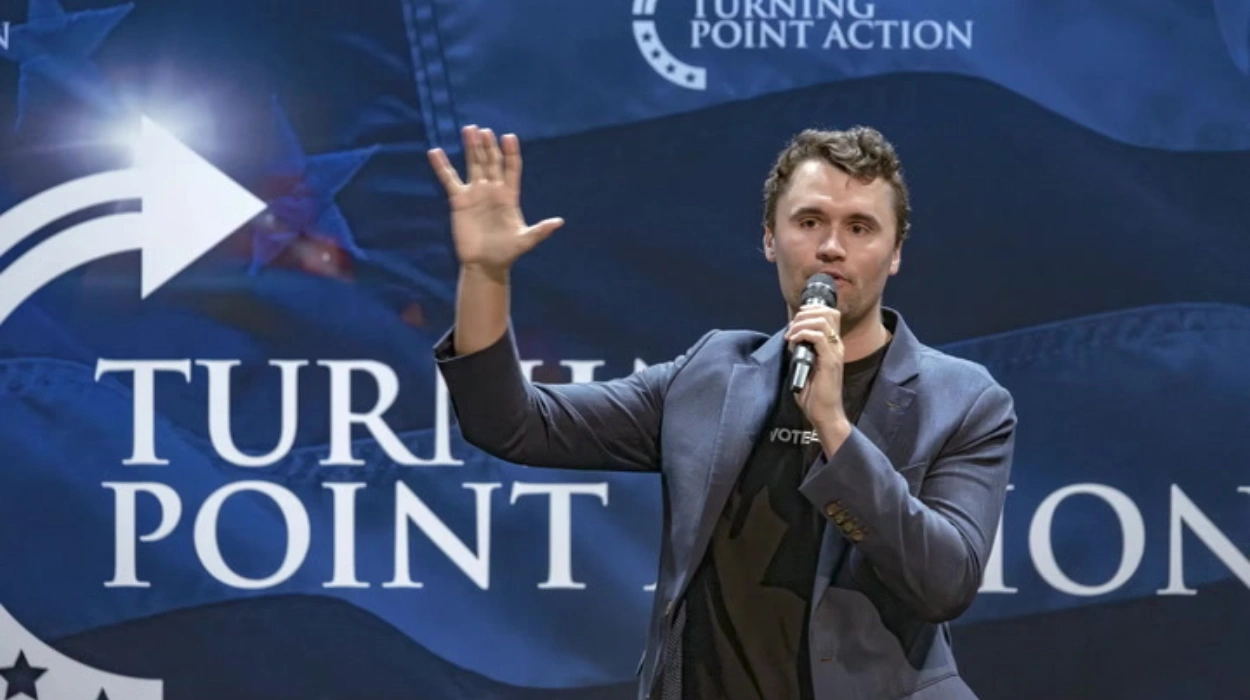

Charlie Kirk was born on October 14, 1993, and grew up in
the suburbs of Chicago, primarily in the communities of Arlington Heights and
Prospect Heights. From a young age, Kirk showed an interest in conservative
politics, motivated by the political environment of his region and family
influence. His early political engagement includes writing essays for
right-wing platforms like Breitbart News during his teenage years, which helped
him develop a reputation among conservative circles as a passionate and articulate
young voice. Despite his early involvement in public discourse, Kirk never
completed a college degree; he briefly attended Harper College, a community
college near Chicago, but left before graduation to fully commit to political
activism. This decision was influenced by his rapid rise in influence through
emerging platforms and organizations that aligned with his ideological beliefs.
Kirk’s childhood and formative years were marked by these foundational
experiences shaping his worldview and setting the stage for his later political
career.
Founder of turning point USA and political rise
At the age of 18, Charlie Kirk co-founded Turning Point USA
(TPUSA) in 2012 with Tea Party activist Bill Montgomery. TPUSA was created to
promote conservative politics and principles (fiscal conservatism, limited
government, and free markets) in high schools and colleges across the United
States. Kirk led TPUSA from a small Midwestern organization overseeing student
debates to a well-funded national conservative activist organization.
Influential donors, such as Foster Friess, were critical for TPUSA to and this
allowed TPUSA to grow rapidly, ultimately creating over 850 college chapters.
Under Kirk’s leadership, TPUSA became one of the most
visible grassroots conservative organizations, engaged in political campaigning
and amplifying the message of the Republican Party, particularly during the
Trump era. Kirk himself was a vocal early supporter of Donald Trump, and was a
key player in redefining youth engagement efforts within the Republican Party.
He implemented controversial programs like the Professor Watchlist and School
Board Watchlist, which aimed to identify and publicly examine the actions of
educators and academics whose values differed from conservative positions.
Opponents criticized the lists, claiming the lists create intimidation and lead
to a chilling effect on academic freedom – despite the backlash the lists
represented an important component of TPUSA’s strategy for influencing
education and culture.
Ideology and Public Influence
Charlie Kirk’s ideology was grounded in a particular style
of populist conservatism, closely aligned to the larger Make America Great
Again (MAGA) movement that surfaced during and after Donald Trump’s
administration. Kirk’s ideological commitments included anti-abortion rights,
opposition to gun control, and a reclamation of what he termed
“traditional family values” and “American heritage.” Kirk’s
Christian nationalism further informed Kirk’s ideological worldview, combining
religious conservatism with political activism in envisioning a faith-oriented
America and promoting American exceptionalism.
A major component of Kirk’s ideological outreach included
his positions surrounding contentious and polarized issues pertaining to
immigration and undocumented migration, race relations, and education policy.
Kirk and Turning Point USA straw-manned liberal arguments on these issues and
framed the debate with messages promoting patriotism, personal freedom, and
economic freedom. He frequently attacked immigration policy he viewed as overly
permissive and linked it with threats to Americans and jobs, various other
forms of American security etc. With race, he was known to often
controversially undercut the prevailing story of systemic racism and the fight
for civil rights can historically be “seen” through the prism of
Thorstein Veblen’s and Robert S. McNamara’s arguments, which received criticism
from people of note.
Kirk openly disparaged the Civil Rights Act of 1964 and
publicly questioned the legacy of Martin Luther King Jr., arguments that were
perceived by many as highly divisive and reflective of a broader conservative
skepticism about social justice movements.
In addition to his political activism, Kirk was also a
prolific media personality, using multiple platforms to amplify his ideological
positions and reach broad audiences, particularly youth. His flagship media
project was “The Charlie Kirk Show,” a conservative talk radio and
podcast program with millions of listeners, through which he broadcast his
viewpoints, engaged with current political issues, and mobilized conservative
grassroots supporters. The show afforded him a substantial platform by which to
influence public opinion, shape conservative discourse, and rally enthusiasm
among young conservatives. His media presence was marked by a combination of
fiery rhetoric, cultural commentary, and partisan analyses, which contributed
to his prominence within right-wing media ecosystems.
Beyond his grassroots activism and media ventures, Kirk’s
influence extended deep into the policy and strategic realms of the Republican
Party. His stature as a key advisor and ally of Donald Trump positioned him at
the nexus of conservative political strategy during a critical period shaping
the direction of American conservatism in the 2010s and early 2020s. Notably,
Kirk was a member of the Council for National Policy (CNP), an influential and
somewhat opaque elite network of conservative leaders, donors, and strategists
that coordinates efforts to advance conservative causes nationally. Through
this membership, Kirk was not only an activist and media figure but also a
policymaker contributing to Republican ideological frameworks and electoral
strategies.
The Council for National Policy has a stereotypical approach
to political issues of impact on religion, a renewed emphasis on traditional
values, and ideals of limited government, of which fits neatly with Kirk’s loud
and brash positions. His affiliation with the CNP also positioned him as part
of a broad coalition that was developing agendas and building up the MAGA
political brand. By aligning TPUSA’s youth activism to this established set of
policy networks, Kirk’s actions are helping to institutionalize populist
conservative values into Republican politics. Kirk’s combined use of mobilizing
the grassroots and operating at upper levels of strategic planning helped to
maximize the extent and longevity of his impact that made populist conservatism
a conventional norm out in the marketplace.
Kirk’s ideological style made use of provocative and
polarizing rhetoric. He had a confrontational style that challenged and sought
to develop narratives that countered progressivism. Sometimes, he used language
and imagery that many critics thought exacerbated social divisions. His use of
conspiracy theories related particularly to the legitimacy of the 2020 U.S.
presidential election, fed into angry political discourse, and enhanced his
identity amongst fringe right-wing groups who were increasingly becoming
enveloped into the mainstream conservative space. While elements of Kirk’s
public persona made him a talking point for criticism, it solidified his image
among a subsection of conservative Americans who thought he was a defiant,
rebellious hero in the face of extreme progressive forces.
Personal life and family
Charlie Kirk was married to Erica France, who you may know
as a podcaster and businesswoman and whose public work is somewhat related to
marriage and family and cultural concerns, approached from a conservative
perspective. Together personally (and within their family), Kirk and France
welcomed two children that added a further layer to Kirk’s public persona, as
he often trumpeted family values within his ideological story. Although a
well-known public figure, Kirk generally kept his kids and family life private
while focusing chiefly on political action, activism, and leadership, and
protecting and preserving his family life from the more extensive media, as
much as was possible.
Unfortunately, Charlie Kirk’s life was cut short on
September 10, 2025 when he was killed in a public community debate at Utah
Valley University. Kirk was shot and killed while participating in a debate
organized by TPUSA. Naturally, this was a violent and sudden end to one of the
most important young conservative activists of the last fifteen years. His
death received significant public condemnation of political violence in the US
and abroad, as there were various expressions of mourning and remembrance from
across the political spectrum.
Legacy and impact
Charlie Kirk’s legacy is one marked by both profound
influence and deep controversy, reflecting the complexity of his role as a
polarizing figure in contemporary American politics. As the founder of Turning
Point USA, Kirk played a pivotal role in reshaping youth conservatism and
amplifying the Republican Party’s influence among younger voters. His rapid
rise from a teenage activist to a national political influencer coincided with
the ascent of the MAGA movement, creating a symbiotic relationship that helped
mobilize a generation under a conservative banner dedicated to free-market
principles, limited government, and traditional values. Kirk’s work left an
indelible impact on the political landscape, especially through his
organization’s extensive network that by 2025 encompassed more than 850
chapters in high schools and colleges across the United States.
Kirk’s role in political organization is well-known in
conservative organizations, especially his efforts focusing on the culture wars
related to education and free speech. Turning Point USA became a leading force
in resisting the penetration of progressive thoughts into college and
universities by confronting what Kirk and supporters labeled as liberal
orthodoxy. The organization spawned projects such as a Professor Watchlist and
School Board Watchlist to research and publicly name educators accused of indoctrination
or promoting left-wing ideologies, fueling a national discussion on academic
freedom and ideological diversity. His actions attracted a base of supporters
who felt aggressively that universities were hostile or, at least, unfriendly
contexts for the endorsement of conservative concepts, yet detractors charged
that lists such as this are intimidation tactics that inhibit the expression of
ideas and ultimately reduce academic rigor.
Kirk’s ideological disposition was based firmly on a
commitment to the tenets of conservatism including opposition to abortion,
support for the Second Amendment, and advocacy for free market economics. Kirk
became an explicit critic of new forms of social movements associated with
race, gender, and sexuality often generating visceral emotional controversies
via incendiary remarks, commentary, and impulsive social media posts. His
enthusiastic philosophical rejection of systemic racism, articulated rejection
of the Black Lives Matter movement, and disapproval of other social movements
advocating for progressive racial justice often alienated, while at the same
time, galvanized support from others. This blend of ideological fervor and
confrontational style helped define both his appeal and the backlash against
him.
Kirk’s tragic demise on September 10, 2025, at Utah Valley
University, where he was shot and killed at a public event, turned his life and
legacy into a national and international spectacle. Kirk’s assassination
reverberated across political communities that have long been plagued by a
discourse of political violence, and motivated discussions about youth
activism, the future of conservative movements, and their significance to civic
engagement. Across the political spectrum, tributes highlighted Kirk’s energy
and charisma, while some examined the troubling aspects of leadership that
produced division, and the attendant culture surrounding divisive political
rhetoric. While Kirk’s death compelled renewed commitments from TPUSA chapters
and conservative youth activists to complete his work, it also encouraged calls
for reflection about the harmful political climate that contributed to
political polarization.
Importantly, irrespective of these divisions, Kirk
successfully mobilized tens of thousands of young people into political
activism, and he transformed countless students into voters organizers who are
now engaged in Republican campaigns and conservative causes. His mobilization
efforts were linked to electoral wins in swing states largely due to
representatives for both cultural influence and political power movement. The
culmination of speeches, an influential social media presence, and signature
efforts, clearly made conservative values attractive and digestible for young
adults experiencing economic stagnation and cultural upheaval.
Kirk’s legacy has sparked conversations about the limits of
political speech, and the responsibilities of public figures. His supporters
described him as a defender of free speech and traditional American values,
while critics claimed that his rhetoric deepened the political divide and
undermined calls for more inclusive democratic dialogue. His public and
public-facing controversies about racism, gender politics, and vote integrity
became flashpoints in larger national disagreements about polarization, misinformation,
and the strength of democracy, which underscore the challenges democracies
encounter in nurturing heated debate while maintaining social cohesion.
After Kirk’s death, many in the movement made public pledges
to carry on and enlarge Kirk’s mission, suggesting the depth of loyalty he
cultivated among young conservatives. Meanwhile, some commentators have called
for thoughtful re-evaluations of how to mobilize political energy to avoid
relapsing into exclusionary extremism. Kirk’s life and career exemplifies the
powerful influence youth leaders can have on the political landscape, the
complex problem of managing mass movements, and the long-lasting imprint one
person can leave in shaping ideology and political culture.
Charlie Kirk’s legacy is a complicated mix of energetic
youth activism, ideological impact, and controversial public discourse. It
demonstrates both remarkable potential and glaring peril when charismatic
leadership coalesces with incendiary momentum in a society predisposed to deep
divisions. The assessment of his impact will continue evolving, shaped by
ongoing political developments and the perspectives of future historians
reflecting on this turbulent period in American politics.