
Summary
- USCIS
now screens immigration applicants for “anti-American” views. - Rule
targets support for terrorism, not political beliefs. - Anti-American
activity weighs heavily in discretionary decisions. - Includes
social media checks and affiliations with extremist groups.
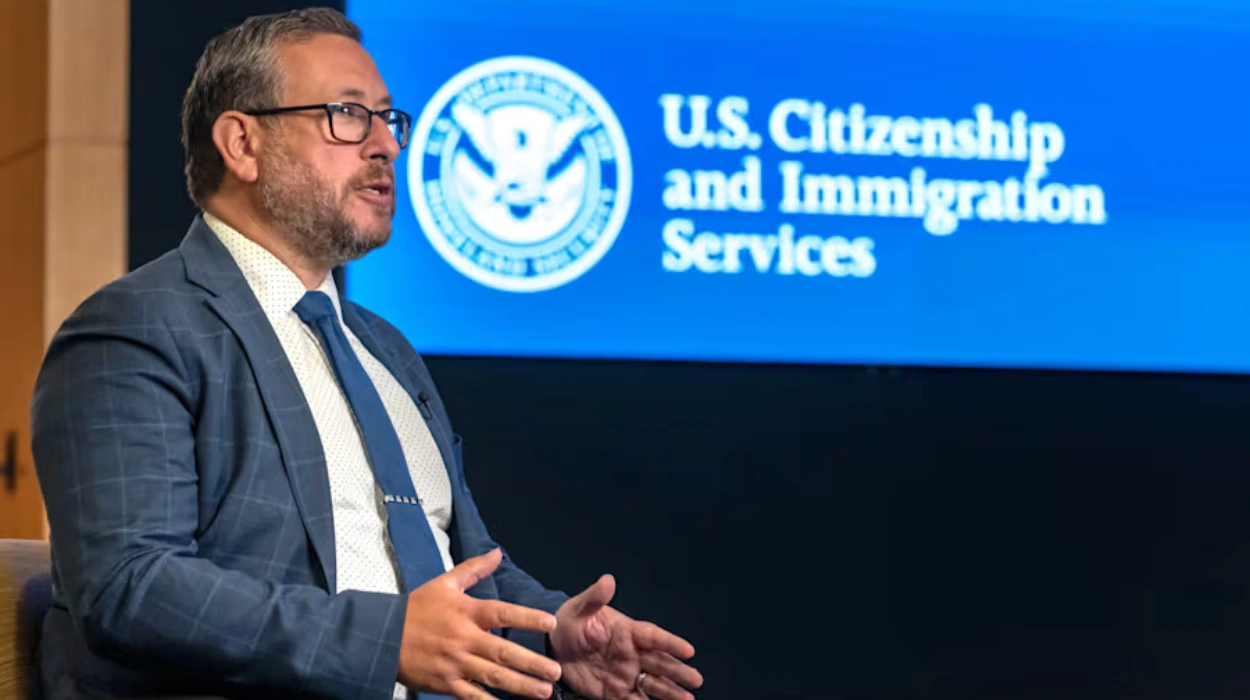
Joseph Edlow, the director of U.S. Citizenship and
Immigration Services, discussed the agency’s controversial policy, which was
announced last month, in a lengthy interview on Monday. It permits officers to
determine whether a foreign applicant for a particular benefit has expressed
what they perceive to be anti-American views.
Edlow also described issues he sees with a training program
that some Trump supporters despise but that is well-liked by overseas students.
He explained how and why he is considering altering the procedure that grants
U.S. citizenship to hundreds of thousands of people annually.
Edlow is in charge of a crucial immigration agency at a time
when President Donald Trump is challenging established immigration laws and
pushing forward with a bold plan that limits who is allowed to enter the
country legally.
According to USCIS’s new guideline, while deciding whether
to provide a benefit, officials may now take into account whether an applicant
“endorsed, promoted, supported, or otherwise espoused” anti-American,
terrorist, or antisemitic sentiments.
Whether it gives police too much discretion to turn away
foreigners based on their subjective assessment was questioned
by some.
According to Edlow, the agency must monitor online comments
made by individuals seeking benefits and determine when such comments turn
hateful. Although it’s a point they take into account, he said the agency won’t
automatically refuse someone a benefit because of what they said.
He stated that they are not searching for anyone who has
uploaded speeches critical of Trump.
“One of the American activities you
can engage in,” he remarked, was criticizing any administration.
“This goes beyond that. This is actual espousing (of) the
beliefs and the ideology of terrorist, of terrorist organizations and those who
wish to destroy the American way of life.”
Edlow cited students who participate in campus rallies where
Jewish students are barred from accessing buildings or who post pro-Hamas
statements as instances of speech that could cause concerns.
Suppressing student protests has been a top aim for the
Trump administration. For voicing opinions the administration deems antisemitic
and “pro-Hamas,” a reference to the Palestinian militant group that attacked
Israel on October 7, 2023, the government has stated that foreign nationals who
take part in such protests need to be barred from the United States.
In one of the most well-known instances, Mahmoud Khalil, a
Palestinian activist and green card holder who was active in Columbia
University’s pro-Palestinian demonstrations while a student, was detained by
federal immigration officials in March.
Edlow stated that in order to gauge applicants’
comprehension of the citizenship process, he is considering making them produce
an essay.
The ‘displacement of American workers’ and H1-B visas
Created in 1990 for those with a bachelor’s degree or higher
in sectors where occupations are considered hard to fill, particularly science,
technology, engineering, and math, the H1-B visa program is frequently linked
to the tech sector. The visa, according to critics, enables businesses to offer
fewer labor safeguards and cheaper wages.
The Republican Party has been particularly embroiled in
controversy about the program. The visas have received backing from wealthy IT
workers, but many Trump supporters are dubious.
It is thought that the White House is considering new
regulations for the program.
“These companies can more easily and cheaply bring in very
experienced foreign workers at the lower wage level, as opposed to having U.S.
employees that you might need to pay at a different level,”
he said.
How will the new anti-Americanism screening impact visa
approvals?
Demonstrations of “anti-American” views,
ideologies or affiliations will have “overwhelmingly negative” weight
in discretionary decisions which could cause more denials of visas, green
cards, work authorizations, or other benefits even where the applicant meets
every legal requirement.
USCIS is concernedly extending social media verification
which will require an evaluation of the applicant’s presence on social media
for evidence of anti-American views, extremist affiliations or support for
terrorist or antisemitic views as part of the determination on applications
which creates even more risk of rejections based on associational or digital
footprints.
The new policy gives immigration officers extreme discretion
to determine what is anti-American either by way of statements or writings or
by affiliation with particular groups. The vagueness of what is anti-American
raises concerns for arbitrary or inconsistent applications.