
Summary
- The
Supreme Court allows the Trump administration to resume immigration raids. - Lifts
lower court ban on stops based on race, language, job. - Ruling
split 6-3; liberal justices issue strong dissent. - Raids
criticized as unconstitutional racial profiling and Fourth Amendment
violations.
The conservative-majority court overturned limitations on
the administration’s forceful immigration raid strategy in a 6-3 ruling,
enabling agents to target individuals based on linguistic and ethnic
characteristics.
The decision “has all but declared that all Latinos, US
citizens or not, who work low-wage jobs are fair game to be seized at any time,
taken away from work,” according to Justice Sonia Sotomayor, who wrote a
dissent for the liberal minority.
The Trump administration’s claims of presidential authority
have hardly ever been restrained by the highest US court.
According to District Judge Maame Frimpong, who claimed
there was a “mountain of evidence” that immigration authorities were
violating the constitutional rights of Los Angeles residents, Monday’s decision
nullifies earlier limits.
“The Supreme Court’s order is outrageous because it includes
no reasoning itself but puts on hold the well-reasoned opinions of the lower
federal courts,”
Cecillia Wang, national legal director of the American Civil
Liberties Union (ACLU), a US watchdog group, said
in a press statement.
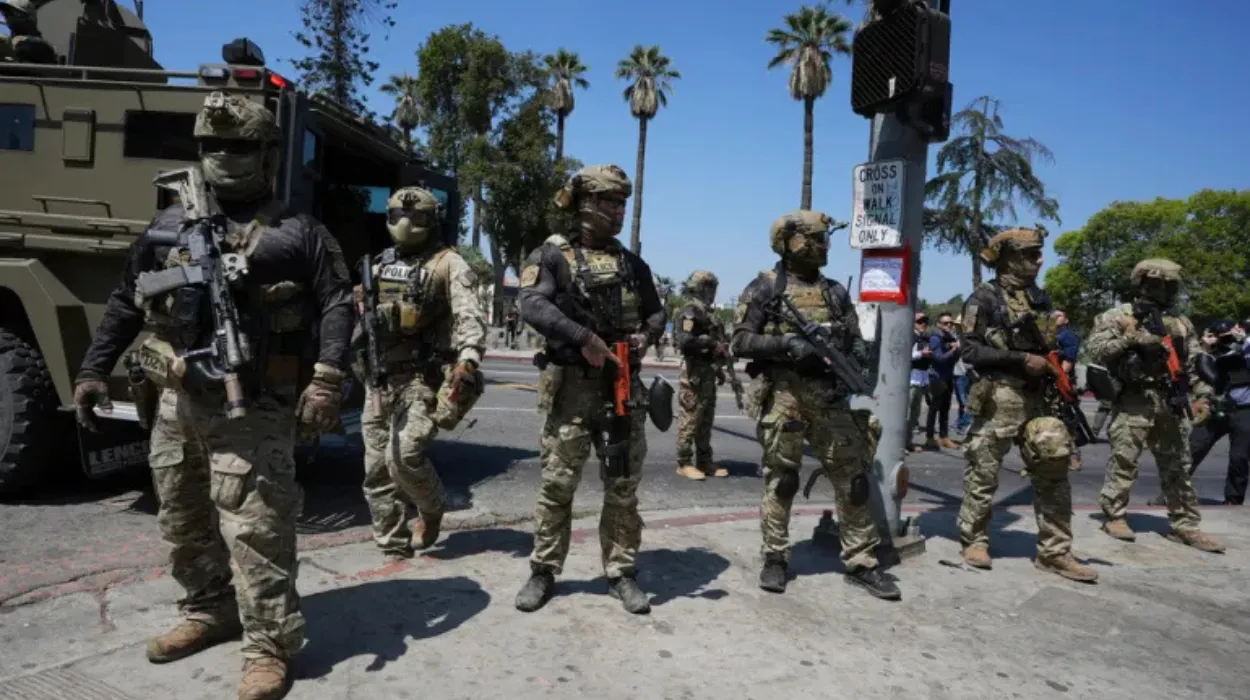
Following the decision, the Department of Homeland Security
(DHS) announced on social media that it will keep “FLOODING THE ZONE”
in Los Angeles, where most of the individuals detained during immigration raids
have no criminal records.
Prior to this, Frimpong had decided that immigration
officials could not single out individuals based on their language, ethnicity,
occupation, or geography. The Trump administration said that the decision
unjustly limited immigration enforcement actions, which have occasionally
apprehended and detained US residents and foreign nationals without legal
status.
“Individuals with brown skin are approached or pulled aside
by unidentified federal agents, suddenly and with a show of force, and made to
answer questions about who they are and where they are from,”
a lawsuit brought
against the government by immigrant rights groups stated.
The draconian immigration policies of the Trump
administration have frequently been motivated by unsupported claims that
immigrants are an “invading” force. Officials and government
organizations have started using terminology that was previously only used by
hard-right anti-immigrant organizations.
Earlier in the day, Trump retweeted a statement on social
media that branded immigration a “weapon of mass destruction”.
How does the Court define “totality of
circumstances” for stops in this ruling?
In a Supreme Court decision authorizing broad immigration
raids in Los Angeles, the Court relied on a well-settled legal principle called
“totality of the circumstances.” This principle measures whether law
enforcement officers had sufficient grounds to stop and detain an individual
(for instance, reasonable suspicion or probable cause).
The Court defined “totality of the circumstances”
as an analytic approach that considers all the relevant factors and the entire
context of a situation, rather than hard bright-line rules or isolated factors.
Examples of evidence including but not limited to: the
person’s conduct, where they are located, the language they speak, their
appearance, or any other contextual evidence that when considered together may
justify the suspicion of law enforcement.