
Summary
- The US ambassador says West Bank development is not
illegal. - Statement made on Israeli Army Radio Monday.
- The US will not oppose West Bank expansion.
- Described development as “massive” and
ongoing. - Comments contrast with international law concerns.
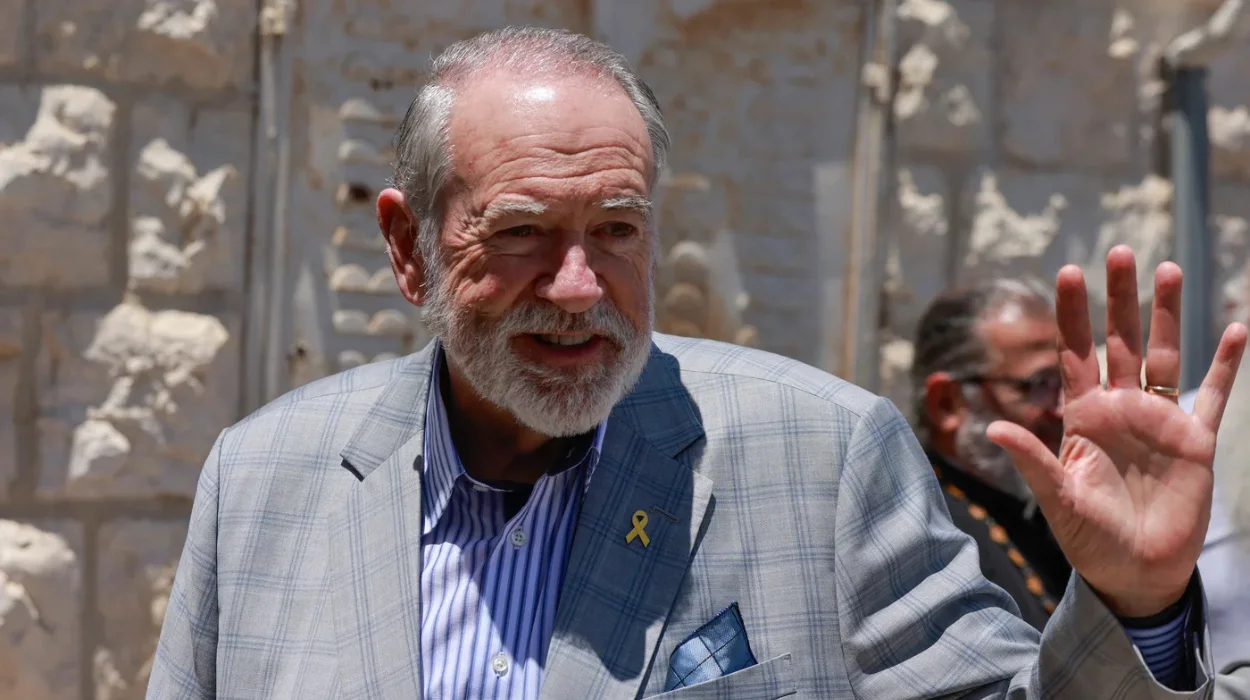
While Mike Huckabee’s comments referred to the
occupied Palestinian territory in totality, he also specifically addressed the
proposed settlement of the E1 area of occupied Jerusalem.
“Whether or not there should be massive
development in E1 is a decision for the government of Israel to make,”
Huckabee said.
“We would not try to evaluate the good and
the bad of that, but simply just say that, as a general rule, it is not a
violation of international law.”
“It’s also, I think, incumbent on all of us
to recognise that Israelis have a right to live in Israel,”
he added.
Omar Shakir, the Israel and Palestine director
at Human Rights Watch, told Middle East Eye that settlement expansion was a
violation of international law and a war crime.
“The answer is yes – the transfer of an
occupying power’s civilian population to a militarily occupied territory
violates the Fourth Geneva Convention and, under the Rome Statute of the
International Criminal Court, is a war crime.”
Shakir also said the US was a signatory to the
Geneva Convention, but the Fourth Geneva Convention has “the status of
customary international law, making it applicable universally”.
In 2020, the European Union and 15 European
countries denounced the plans to develop E1 in a protest letter, the second of
its kind.
“Settlements are illegal under
International Humanitarian Law. Any further settlement construction in this strategically
sensitive area will have a devastating impact on a contiguous Palestinian
State, as well as severely undermining the possibility of a negotiated
two-state solution in line with internationally agreed parameters,”
the
letter said.
The remarks made by Mike Huckabee follow Finance
Minister Bezalel Smotrich’s announcement on Thursday that he intended to
restart the E1 region settlement project, which would see thousands of new
homes built in the E1 area, east of Jerusalem.
By doing this, the occupied West Bank would be
divided in two, isolating Palestinian communities and uniting Jerusalem with
the illegal Ma’ale Adumim settlement, which is located several kilometers to
the east.
Smotrich hailed the plan as
“a reality that
buries the idea of a Palestinian state, because there’s nothing to recognize
and no one to recognize it”
when he made the announcement.
Decades after it was first proposed, the E1
settlement was shelved due to international censure from both governments and
human rights organizations.
This week, the Israeli government was supposed
to approve the E1 construction plans. Israel was advised by the UN not to begin
construction on the settlement.
Stephane Dujarric, the UN secretary-general’s
spokeswoman, told reporters that the unlawful expansion of the E1 settlement
“would put an end to prospects of a two-state solution.”
“Settlements go against international law…
[and] further entrench the occupation,”
Dujarric said.
Quds Network described the proposal as a
“death sentence to establishing the Palestinian state”.
What legal basis does the US cite for supporting
Israeli settlement development in the West Bank?
In November 2019, the Trump administration, via
Secretary of State Mike Pompeo, announced that it no longer considers Israeli
civilian settlements in the West Bank to be “inconsistent with
international law.”
This marked a significant departure from
previous U.S. positions which often described settlements as obstacles to peace
or violations of international law.
Traditionally, the U.S. stance, in line with
most of the international community, viewed Israeli settlements in occupied
territories as a violation of Article 49 of the Fourth Geneva Convention, which
prohibits an occupying power from transferring its population into occupied
territory. However, successive U.S. administrations maintained a nuanced
approach, often avoiding labeling settlements outright illegal to avoid
hampering their peace efforts.